
In 2025 the question was "which API has the best data." In 2026 it is "which API your agent can actually call without breaking." That shift is why the rankings of the best B2B data APIs 2026 look different from last year. Coverage and pricing still matter. Agent-native interfaces matter more.
An AI-native GTM team running Claude Code or a Python agent needs three things from a data API that single-database providers historically did not optimize for: an MCP or SDK, predictable schemas the agent can reason over, and waterfall coverage that does not return blanks halfway through a batch. Here is the honest read on the 10 providers that actually meet that bar in 2026, and where each one wins.
Quick Picks
Best for AI-native GTM stacks: Databar API (100+ providers, MCP, SDK, REST)
Best for GDPR-compliant EMEA data: Cognism API
Best for live web research alongside structured data: Exa API
What "AI-Native" Means in B2B Data APIs
The phrase gets used loosely. For a B2B data API in 2026, it has a specific definition. An AI-native API is one where any of these are true:
An MCP server is available. Not optional. Agents in Claude Code and similar runtimes call tools through MCP. APIs without an MCP wrapper require custom adapter code, which most GTM teams will not write.
The schema is predictable enough for an agent to reason over. Inconsistent field names across endpoints, optional fields that may or may not appear, and undocumented response shapes break agent workflows.
Waterfall or fallback coverage exists. Single-source coverage gaps cause agents to silently fail. APIs that route across multiple sources or expose clean fallback patterns survive at scale.
Caching is a given. Agents re-query the same contacts across overlapping campaigns. APIs without server-side caching burn credits twice on the same lookup.
None of these are nice-to-haves at production scale. Pull on any one of them when evaluating a data layer for AI agents and you will see why most direct vendor APIs fall short of what agents actually need.
Comparison Table: Best B2B Data APIs 2026
API | Best for | Agent-native interfaces | Coverage model | Pricing |
|---|---|---|---|---|
Databar API | AI-native GTM stacks | MCP, SDK, REST | 100+ providers aggregated, waterfall | Free trial, From $99/mo |
ZoomInfo API | US enterprise depth | REST | Single source (proprietary database) | Enterprise contracts |
Apollo API | US mid-market contacts | REST, MCP | Single source | From $49/seat/mo |
Cognism API | EMEA-compliant data | REST | Single source | Enterprise contracts |
People Data Labs API | High-volume identity | REST, SDK | Single source | Tiered subscription |
Prospeo API | LinkedIn-to-email + mobile | REST, MCP | Internal cascade across methods | Tiered monthly credits |
Hunter API | Email finding on a budget | REST, MCP | Single source | From $34/mo |
Lusha API | Sales-team enrichment | REST | Single source | Tiered seat-based |
6sense / Bombora API | Intent and tech signals | REST | Single source (intent network) | Enterprise contracts |
Exa API | Live web research | REST, MCP | Web index | Usage-based |
Databar API
Best for: AI-native GTM stacks that need agent-callable breadth in one integration
Databar is an aggregator. One API surface routes across 100+ providers covering company data, contact data, email, phone, tech stack, intent, funding, and job-posting signals. The agent calls one endpoint. Databar handles routing, fallback, and verification.
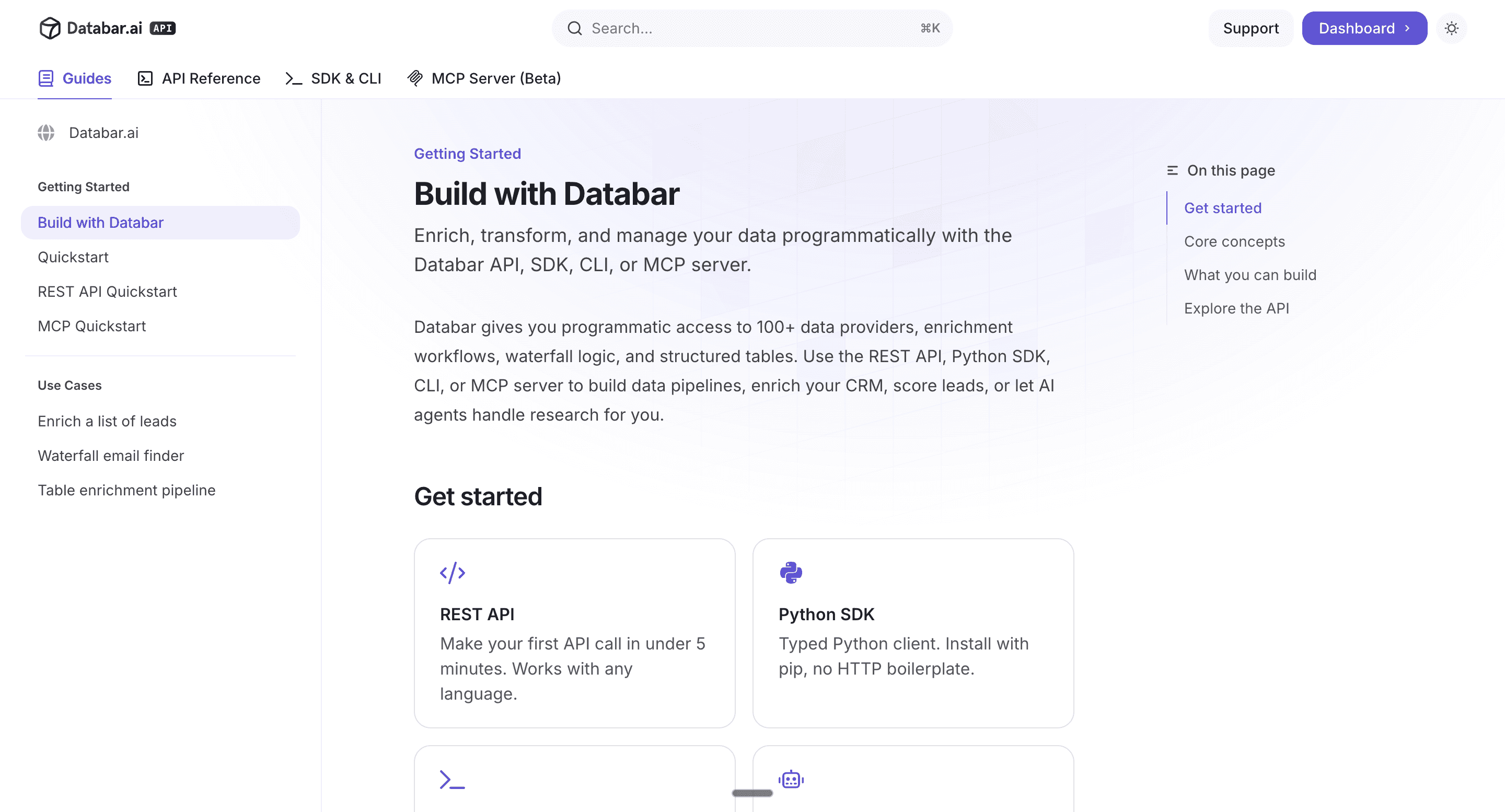
For AI-native teams, the differentiator is that all three agent surfaces are first-class: MCP for interactive Claude Code work, Python SDK for production scripts, and REST API for any other runtime. Schemas are normalized across providers, so the agent does not waste tokens reasoning about which source returned what.
Pricing: Credit based-pricing & you only pay if data is successfully returned. Free tier with limited credits. Setup at build.databar.ai takes under two minutes.
Pros:
Only API on this list with built-in waterfall, and verification across 100+ providers
Three agent-native surfaces (MCP, SDK, REST), same data layer behind all of them
Match rates around 85% in waterfall mode versus around 50% on most single-source APIs
Cons:
Choosing the right provider per use case has a small learning curve given 100+ options
ZoomInfo API
Best for: US enterprise data depth in a single proprietary database
ZoomInfo's API gives you direct access to one of the deepest US enterprise B2B datasets. Production reliability is solid at the enterprise tier. The friction for AI-native teams is that the API is REST-only with no native MCP, so agents need a custom wrapper to call it cleanly.
Pricing: Enterprise contracts, typically five figures annually.
Pros:
Deepest single-source US enterprise contact and intent data
Mature API with solid uptime track record
Cons:
No native MCP; agents need custom tool wrappers
Rigid licensing does not map cleanly to agent-driven consumption
Apollo API
Best for: US mid-market teams running moderate-volume agent workflows
Apollo's API is a popular starting point because it is well-documented and an MCP exists. The limitation for AI-native teams is single-source coverage. When Apollo misses, the agent has nothing. Pair it with an aggregator or a complementary provider for waterfall coverage.
Pricing: From $49/seat/mo for paid plans.
Pros:
Solid US mid-market coverage
MCP available; agent integration is low-friction
Cons:
Single source; no native fallback
Lower-tier rate limits constrain large batch jobs
Cognism API
Best for: EMEA-focused workflows that need GDPR-compliant verified data
Cognism leads on EMEA compliance and verified mobile numbers. Production reliability is strong on enterprise tiers. Like ZoomInfo, the API is REST-first; agent integration usually goes through a custom wrapper or via an aggregator that already routes through Cognism.
Pricing: Enterprise contracts.
Pros:
Best-in-class EMEA compliance and phone-verified data
Strong support for direct-dial outbound motions
Cons:
Procurement-heavy, slow to set up
Single source; needs complementary providers for global coverage
People Data Labs API
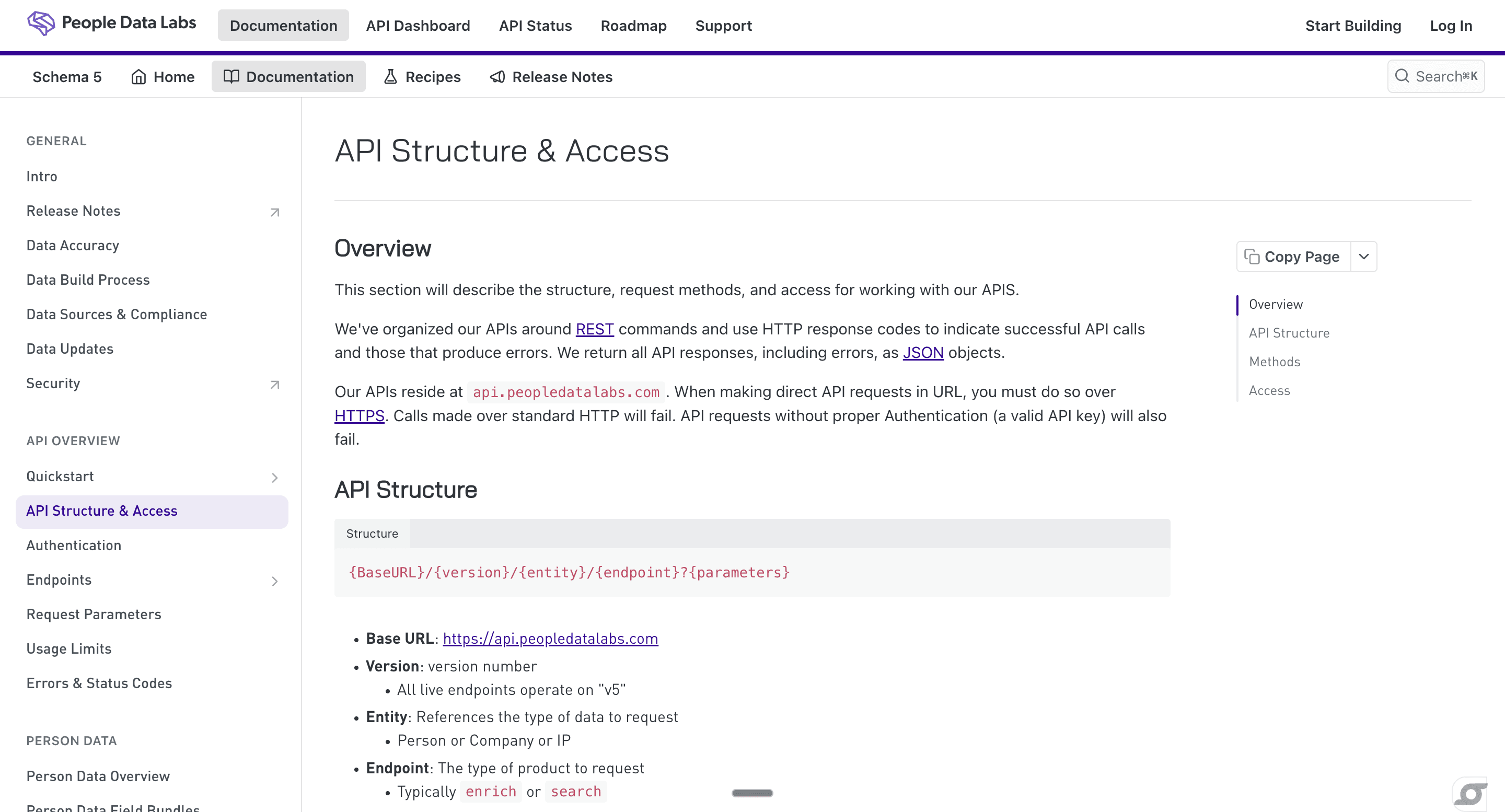
Best for: High-volume identity matching and enrichment at scale
PDL is built for batch and high-volume B2B identity matching. Generous bulk endpoints make it agent-friendly for large jobs, and an SDK exists for Python workflows. Single source, so coverage gaps are still a concern; pair with an aggregator for production reliability.
Pricing: Tiered subscription with usage-based scaling.
Pros:
Generous rate limits and bulk endpoints
Strong for identity-resolution-heavy workflows
Cons:
Single source; coverage gaps require fallback
Less useful for narrow workflows than for breadth-heavy use cases
Prospeo API
Best for: Agent workflows that depend on LinkedIn-to-email resolution
Prospeo runs internal cascades across multiple email-finding methods, which lifts match rates above pure single-method tools. An MCP exists, so agent integration is low-friction. Best fit when LinkedIn-first prospecting is the core motion.
Pricing: Tiered monthly credit subscriptions.
Pros:
Strong LinkedIn-to-email resolution and mobile lookup
MCP available
Cons:
Email and mobile data only; no firmographics or signals
Single vendor; coverage capped vs a 100+ provider aggregator
Hunter API
Best for: Narrow email finding and verification at low budget
Hunter is the cleanest single-purpose email API. An MCP exists, which is rare in this category. Production reliability is fine for the narrow workload. Not a replacement for broader enrichment.
Pricing: From $34/mo.
Pros:
Reliable email verification
Simple pricing and clean docs
Cons:
Email only; no contact, company, or signal data
Strict rate limits on lower tiers
Lusha API
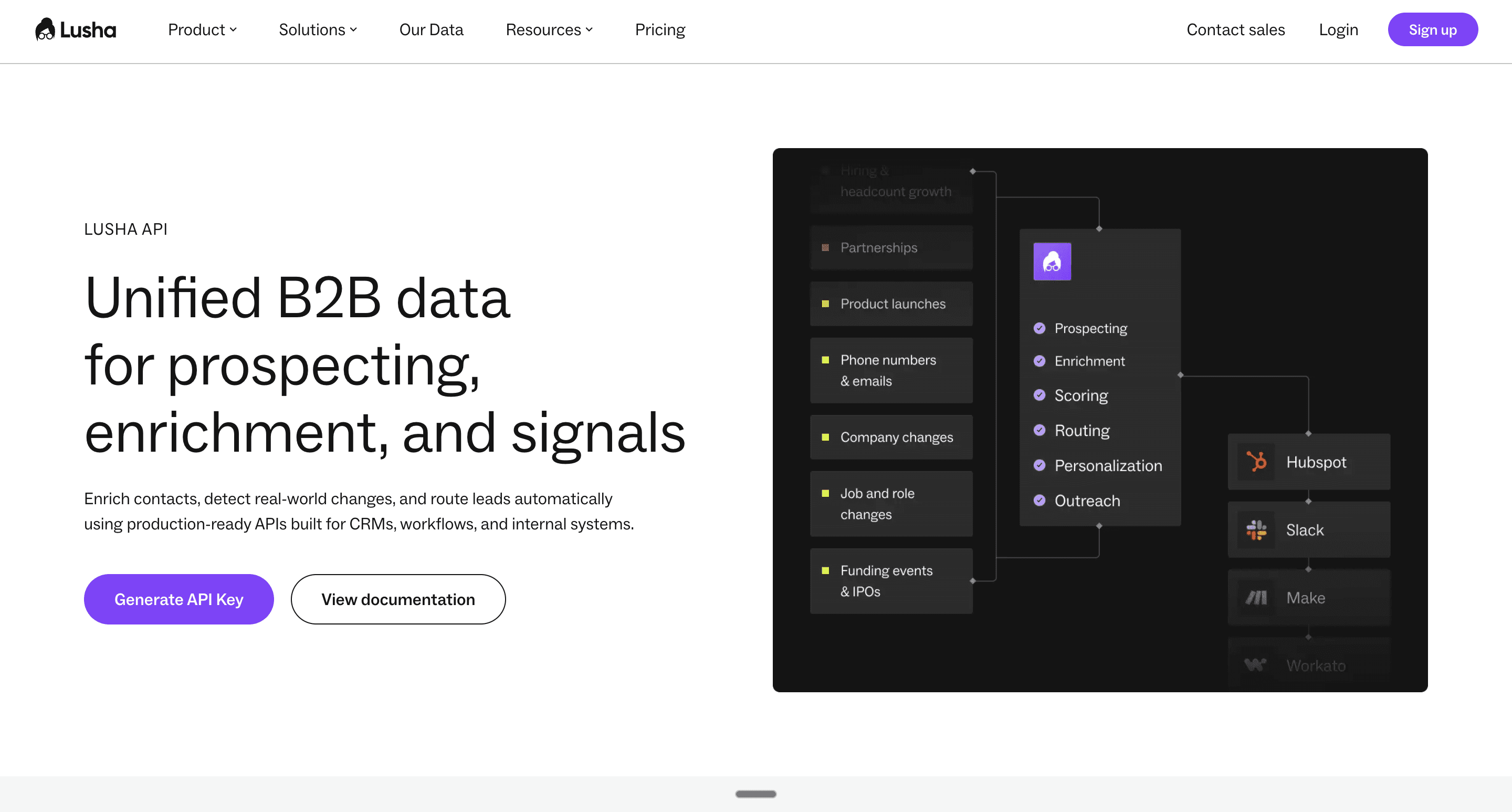
Best for: Sales-team enrichment workflows with verified contact data
Lusha is sales-team friendly with reasonable docs and a focus on verified contacts. REST-only; no native MCP. Single source means production agent workflows still need fallback through an aggregator or a complementary provider.
Pricing: Tiered seat-based plans.
Pros:
Verified contact data for sales rep workflows
Clean documentation and quick setup
Cons:
No native MCP; agent integration needs a wrapper
Single source; fallback is on you to handle
6sense and Bombora API
Best for: Intent signals feeding agent prioritization
6sense and Bombora are the two main sources of third-party B2B intent data. Most other intent products under the hood are one of these. AI-native teams use these APIs to score accounts, prioritize outbound, and time campaigns to buying windows. Not a standalone enrichment source; pair with contact data.
Pricing: Enterprise contracts.
Pros:
Broadest third-party intent networks available
Strong for account prioritization
Cons:
Noise-heavy; requires thoughtful agent logic to convert signals to action
Procurement friction
Exa API
Best for: Live web research alongside structured B2B data
Exa is a search API agents use for web research, competitor checks, news triggers, and content grounding. An MCP exists. Useful alongside structured data APIs, not as a replacement. Fills in research gaps that no structured provider covers.
Pricing: Usage-based.
Pros:
Great for grounding agent outputs in recent information
Native MCP for agent runtimes
Cons:
Not structured B2B data; still need enrichment APIs for contacts and firmographics
Agents can over-use search and burn context window budget
How to Pick Among the Best B2B Data APIs 2026 for Your Stack
Most AI-native GTM teams converge on the same architecture. One aggregator for breadth, one specialized provider for the depth gap that matters most, and optionally one signal source.
Tipically, two or three contracts is the production sweet spot. The aggregator handles 80% of the workload and keeps the architecture clean. Specialized providers fill gaps where depth matters more than breadth. The same pattern shows up in our broader comparison of the best data providers for AI agents.
Start With the Right Layer for Your AI-Native Stack
The best B2B data APIs 2026 are the ones that give your agent something usable on the first call, not the third. Coverage, waterfall, and agent-native interfaces matter more in 2026 than the data depth comparisons that defined 2025.
Databar is the breadth layer for most AI-native GTM stacks. 100+ providers, MCP, SDK, REST. Setup at build.databar.ai takes under two minutes.
FAQ
What are the best B2B data APIs in 2026?
For AI-native GTM teams in 2026, the strongest providers are Databar (100+ aggregated providers with MCP and SDK), ZoomInfo (US enterprise depth), Apollo (US mid-market), Cognism (EMEA compliance), People Data Labs (high-volume identity), and Prospeo (LinkedIn-first email). Most production stacks use Databar as the breadth layer and add one or two specialized providers for region-specific depth.
What changed between 2025 and 2026 in B2B data APIs?
Two things. First, MCP went from an emerging standard to a baseline requirement for agent-driven workflows. Providers without an MCP fell behind because GTM teams cannot afford to write custom wrappers for every API. Second, single-source coverage stopped being acceptable for production agent workloads. Match rates around 50% break agents that cannot improvise the way humans do.
What does "AI-native" mean for a B2B data API?
An AI-native API has at least three of these: an MCP server, a Python or Node SDK, predictable schemas across endpoints, server-side caching, and waterfall or fallback coverage. APIs that meet none of these will require custom adapter code from your engineering team to be usable in agent workflows.
Do I need an MCP for every B2B data API in my stack?
For interactive agent workflows in Claude Code, yes. For production batch jobs running through a Python SDK, MCP is optional. Most teams pick APIs where MCP exists for prototyping and switch to the SDK for scaled execution. Aggregators that expose all three surfaces (MCP, SDK, REST) collapse that choice.
Why are aggregators favored for AI-native GTM stacks?
Two reasons. Coverage: agents fail silently when single-source enrichment misses, and waterfall across 100+ providers lifts match rates from around 50% to around 85%. Operational simplicity: managing five direct API contracts means five auth flows, five rate-limit policies, and five schema migrations per quarter. One aggregator collapses that into one integration.
Can I use Databar as my only B2B data API?
For most AI-native GTM workflows, yes. Databar covers 100+ providers across the major data types: contact, company, email, phone, tech stack, intent, funding, signals. Some teams add a specialized direct contract for one specific region or data type where the depth matters more than breadth, but the aggregator handles the bulk of the workload.
How do I migrate from a single B2B data API to an aggregator?
Start the aggregator side-by-side with your existing API. Run your highest-volume workflow through both and compare match rates and cost. Once the aggregator wins on overall output, migrate the workflow over. Keep specialized providers that genuinely outperform the aggregator on a specific dimension; drop the others. Most teams complete this in one to two weeks.
Also interesting
Recent articles
See all