Finding affordable ZoomInfo alternatives doesn't mean sacrificing data quality. In 2026, several platforms sell B2B contact and company data at a fraction of ZoomInfo's enterprise pricing. Which one fits depends on where you sell and how you consume the data, and this guide sorts them on exactly those two axes.
This analysis cuts through marketing claims to examine how each ZoomInfo competitor truly performs across data quality, pricing transparency, user experience, and integration capabilities. We'll highlight which alternatives excel for different team sizes, industries, and use cases, so you can make a confident decision about which platform will deliver the best return on your investment.
Everything quoted below came off the vendor's own pricing page in September 2026. Where a vendor hides its prices behind a sales call or a JavaScript bundle, we say so rather than repeating a number from somewhere else.
What You Get Instead of a ZoomInfo Contract
Tool | Best for | Pricing model | Entry price (Sept 2026) | Free tier |
|---|---|---|---|---|
Databar.ai | Multi-source coverage without a procurement cycle | Outcome-based credits | $99/month, 5,000 credits | Yes, plus 14-day trial |
Apollo.io | US mid-market, data plus sending | Seat-based | $49/user/month | Free Starter plan, allowance not published |
Lead411 | Intent signals without an enterprise commit | Export-based tiers | $49/month, 1,000 exports | 7-day trial, 50 exports |
Cognism | GDPR-compliant EMEA mobiles | Annual contract, 5 seats | Quote only | No |
UpLead | Accuracy guarantee on a small database | Credits | $74/month billed annually | 7-day trial, 5 credits |
Hunter.io | Email discovery and verification only | Credits, no seat charge | EUR 49/month, 2,000 credits | 50 credits/month |
LeadIQ | LinkedIn capture into Salesforce | Tiered credits | $200/month (Pro) | 50 credits |
Lusha | Rep-level browser lookups | Seat plus credits | Tiers not published; 1 credit per email, 5 per phone | 40 credits/month |
SignalHire | Technical talent across email, phone, social | Credits | $69/month, 1,000 email credits | 5-10 credits |
Snov.io | Email finding plus sending on a budget | Credits, unlimited seats | $39/month, 1,000 credits | Renewable trial, 50 credits |
Seamless.AI, RocketReach, Clearbit and LinkedIn Sales Navigator are covered in full below. Their pricing is either quote-only or not published in a form we could verify.
Understanding ZoomInfo: Features, Pricing, and Limitations
Before diving into alternatives, let's establish why many organizations are searching for ZoomInfo alternatives in the first place.
ZoomInfo has established itself as a leader in the B2B data space, offering:
Extensive database of business contacts and company information, with verified records on over 100 million professionals and 14 million companies.
Advanced search and filtering capabilities
Intent data to identify potential buyers
Integration with major CRMs and sales tools
Built-in engagement features
However, ZoomInfo's enterprise focus comes with significant drawbacks:
High cost barrier: Starting prices typically range from $15,000-$20,000 annually for basic plans, with more comprehensive packages exceeding $30,000-$40,000 per year
No public pricing: ZoomInfo does not publish rates, so every comparison starts with a sales call. As a public benchmark, procurement platform Vendr reports a median contract value of $33,500 per year across 1,572 ZoomInfo purchases (checked September 2026).
Annual contracts: Most plans require 12-month commitments with limited flexibility
Complex pricing: Tiered structure with numerous add-ons that can quickly inflate costs
Feature restrictions: Many advanced capabilities are locked behind premium tiers
Implementation complexity: Full deployment can take weeks, especially for larger organizations
These limitations have created a market opportunity for more accessible, flexible alternatives that better serve small to mid-sized businesses and teams with specialized needs.
The Three Reasons Teams Actually Leave
In practice the decision comes down to one of three things, and knowing which one is yours shortens the shortlist fast.
Cost at your specific volume. ZoomInfo's pricing is built around enterprise commits. If your team needs occasional access, or runs outbound from a lean team, the seat math rarely works. Consumption and outcome-based models change the arithmetic entirely for smaller teams, because you stop paying for capacity you do not use.
Coverage outside US enterprise. ZoomInfo is deepest where it has always been deepest. Selling into EMEA, APAC or US SMB tends to surface gaps that a regional specialist or a multi-source aggregator fills better. On the lists we run, a single provider lands in the 50s or low 60s and a cascade across several complementary sources lands in the 80s. Those are ranges we observe, not a published benchmark.
Procurement friction. Multi-year contracts, seat-based licensing and restricted API access at lower tiers. None of that suits a team that wants to spin up a campaign this afternoon. Self-serve alternatives remove the bottleneck outright.
None of these are arguments that ZoomInfo's data is bad. They are arguments that the package fits some teams and not others.
Key Criteria for Evaluating ZoomInfo Alternatives
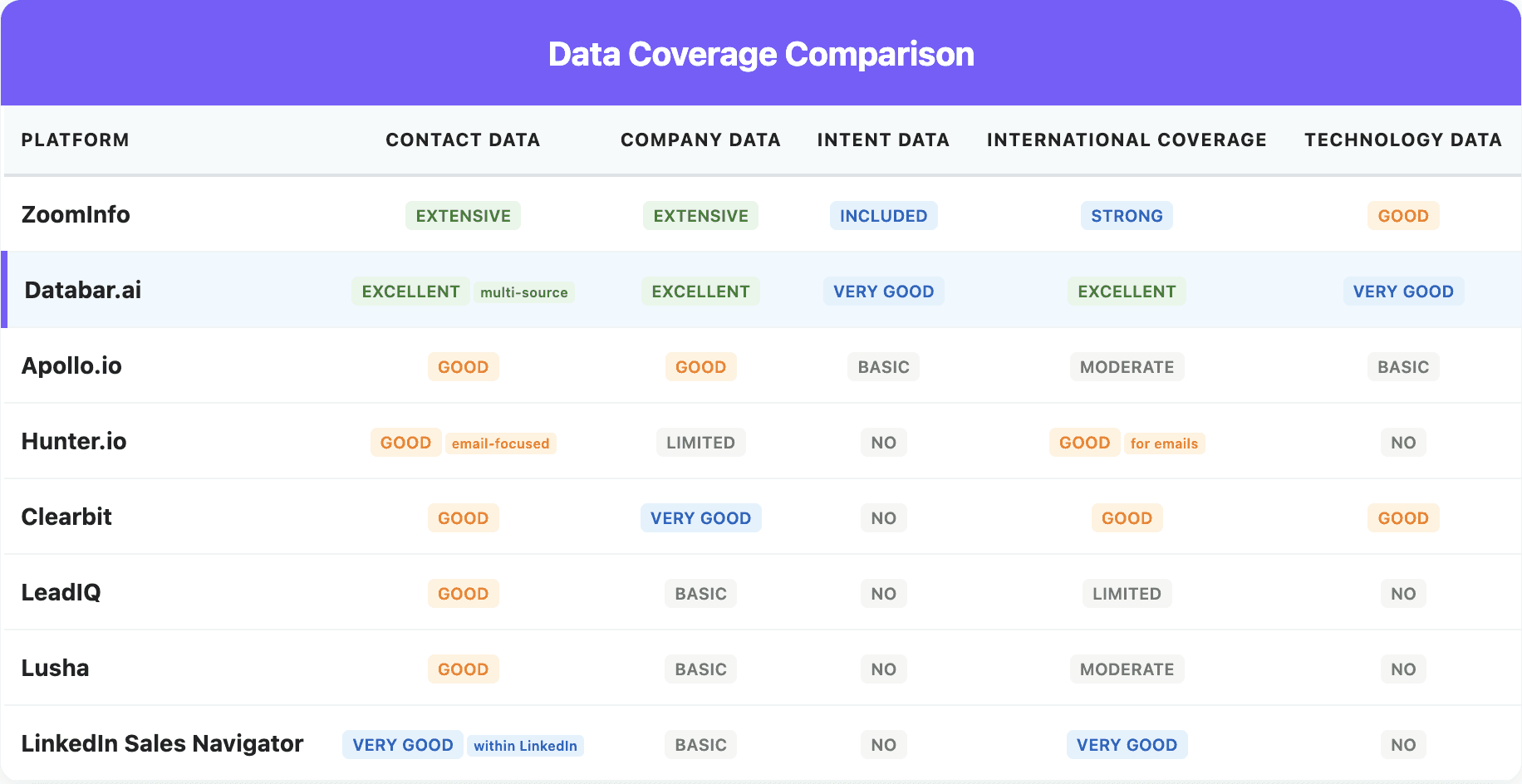
When assessing ZoomInfo alternatives, focus on these five critical factors:
Data Quality and Coverage
The value of any B2B data platform depends on the accuracy, freshness, and comprehensiveness of its information. Consider:
Match rates for your specific target industries and regions
Data accuracy and verification processes
Refresh frequency to ensure information remains current
Global coverage if you operate internationally
Depth of information including direct dials, mobile numbers, and verified emails
Pricing and Value
Price shouldn't be the only consideration, but the value relative to cost is crucial:
Transparent pricing with clear understanding of what you're paying for
Flexible contracts versus long-term commitments
Scalability as your team and needs grow
Cost per matched record, not cost per lookup. At a 55% match rate, a five-cent lookup works out at $0.09 for every record you can actually use; a ten-cent cascade that matches 85% of the time works out at $0.12, and leaves you with 55% more usable records from the same list.
User Experience and Learning Curve
Even the most comprehensive data platform provides little value if your team struggles to use it effectively:
Intuitive interface that requires minimal training
Workflow integration with your existing processes
Search functionality that makes finding relevant prospects straightforward
Customization options to tailor the platform to your specific needs
Integration Capabilities
Your data enrichment solution should connect cleanly with your existing tech stack:
Native integrations with your CRM, marketing automation, and sales engagement tools
API access for custom implementations
Programmatic surfaces if a script or an AI agent, rather than a rep, is the consumer. Which of those surfaces you actually need is its own question, and our comparison of MCP, SDKs and plain APIs works through it.
Export capabilities for batch processing
Real-time enrichment options for on-demand data
Compliance and Data Privacy
With increasing regulation around personal data, ensure any alternative:
Maintains GDPR, CCPA, and other regional compliance
Provides transparency about data sources
Offers documentation for compliance teams
Updates practices as regulations evolve
Top ZoomInfo Alternatives in 2026
Based on our analysis, these platforms offer the strongest alternatives to ZoomInfo across different need profiles:
Databar.ai
Best for: Broad coverage without a procurement cycle
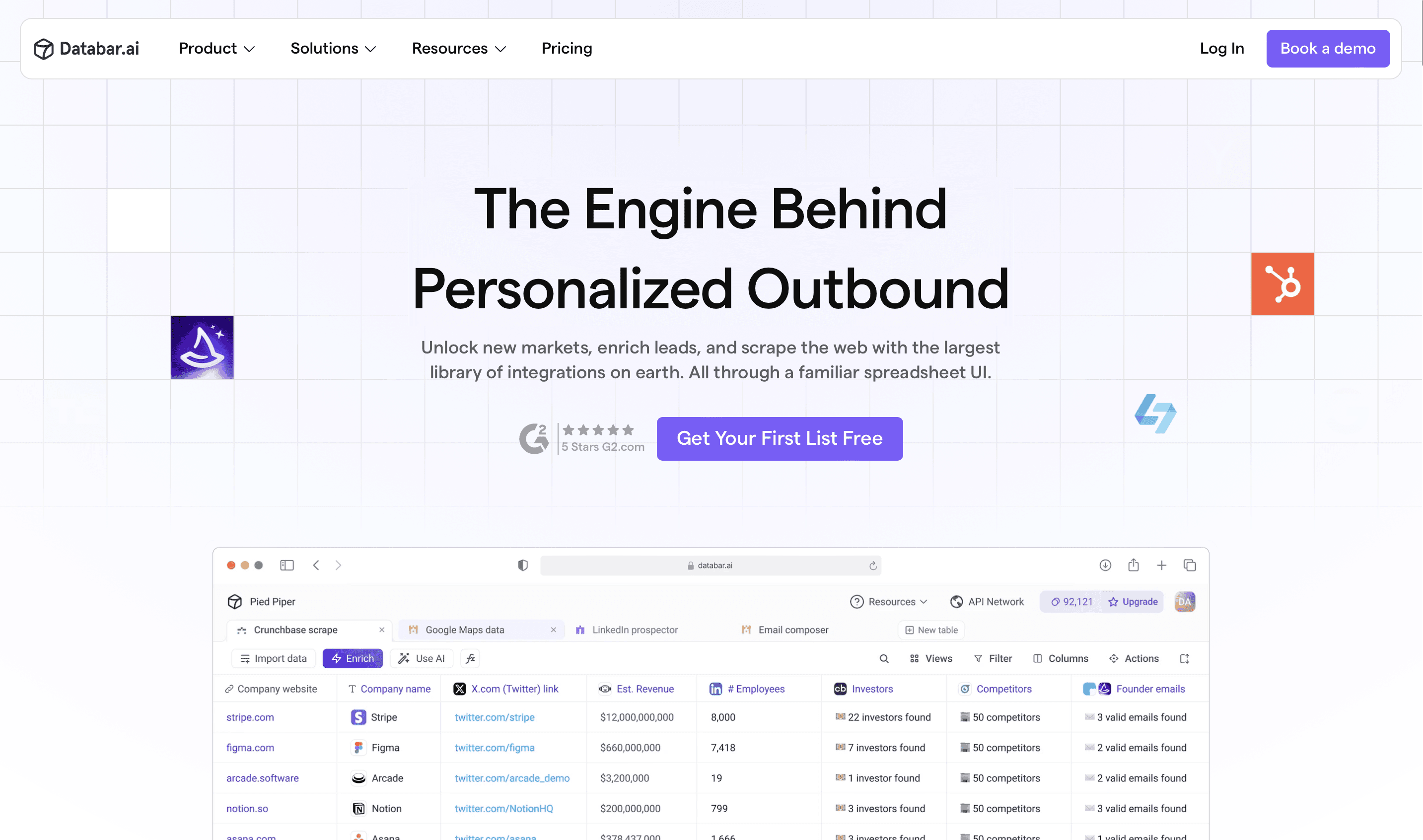
Databar.ai is a multi-source aggregator that connects users to 100+ data sources and 160+ integrations through a single interface. Unlike ZoomInfo's proprietary database approach, Databar.ai gives users access to a wider range of sources while keeping the entry point self-serve.
Key Strengths:
Transparent pricing: Published plans starting at $99/month with no sales call required
Outcome-based billing: You only pay when data is successfully returned. In a waterfall, only the provider that returns data is charged and empty lookups are free.
Simple implementation: Live in hours rather than weeks, with no procurement cycle
Flexible data access: Connect to 100+ sources without managing multiple subscriptions or vendor contracts
Automation: build enrichment workflows in the table, or drive the same workflows from the REST API, Python SDK, CLI or hosted MCP server
Comprehensive integrations: One-click connections to major CRMs and marketing platforms
For teams that want the capabilities and the data access without the enterprise price tag, Databar.ai combines accessibility, flexibility and power, and the built-in charting and mapping mean you can analyze a list in place rather than exporting it. The provider catalog is where you see what you would actually be buying.
Honest limits: Databar is not a prospecting database, so there is no search-by-title-and-industry to build a list from scratch. No intent data of ZoomInfo's depth and no org charts. Picking the right providers from a 100-source catalog takes a session to get right.
Pricing: Build $99/month for 5,000 credits, Scale $495/month for 50,000 credits, Enterprise custom. Every workspace gets a 14-day full-product trial with 100 credits. Every workspace starts with 100 free trial credits (September 2026).
See Databar.ai plans and start the trial.
Apollo.io
Best for: US mid-market teams that want data and sending on one invoice
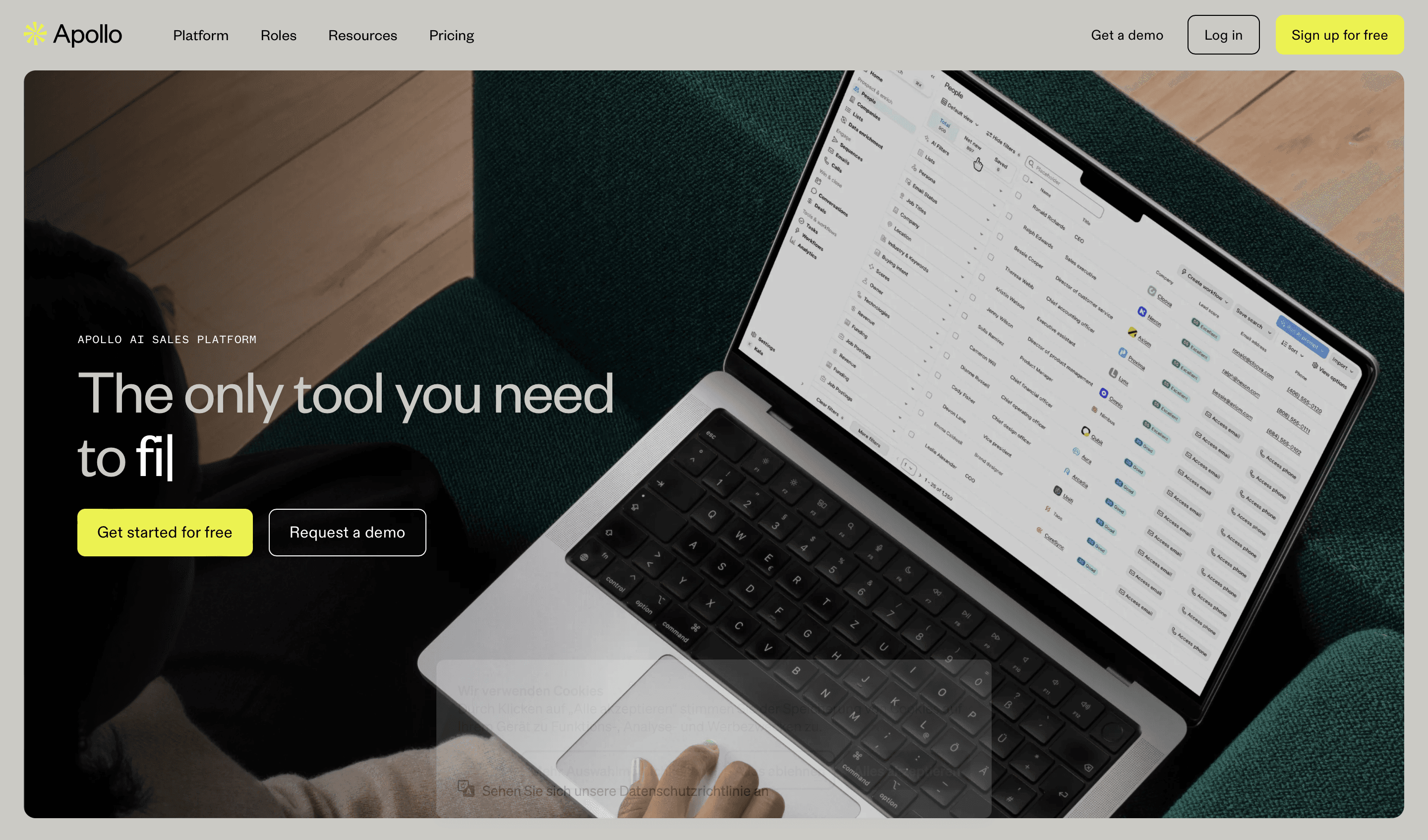
Apollo.io positions itself as an integrated sales intelligence and engagement platform, combining data enrichment with outreach capabilities.
Key Strengths:
Unified platform: Contact data, enrichment, and outreach in one solution
Buyer intent data: Similar function to ZoomInfo's at a much lower price point
Free tier available: The most generous free plan among ZoomInfo alternatives
Chrome extension: Enrich LinkedIn profiles while browsing
Apollo.io works well for sales teams who want combined data and outreach at a fraction of ZoomInfo's cost, and it has a free tier, though its proprietary database can be thin in certain industries.
Honest limits: Single-source coverage, so when Apollo's database misses, the row comes back blank with no fallback. International coverage is thinner than US coverage. API rate limits scale with seat tier, which throttles batch work.
Pricing: A free Starter plan that stays free, Basic at $49 per user per month, Professional at $99 per user per month, Enterprise on quote. Apollo's plan table renders client-side, so those figures come from the structured data the page publishes, and the per-tier credit allowance is not stated on the page at all (September 2026). Get the allowance from Apollo in writing before you compare it against a ZoomInfo quote.
Hunter.io
Best for: Teams whose only gap is email discovery
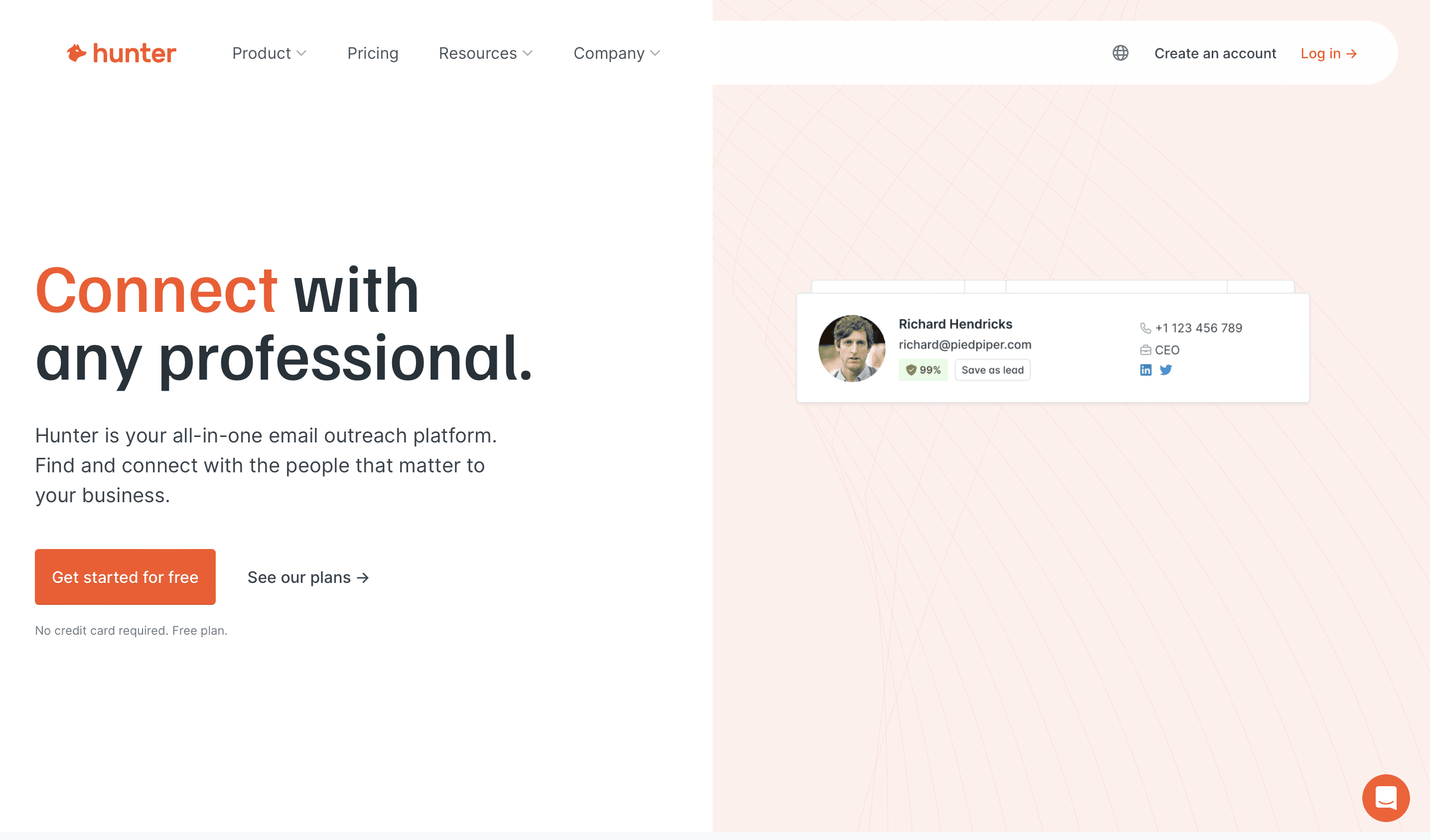
Hunter.io specializes in email finding and verification rather than comprehensive contact data, making it a more focused alternative.
Key Strengths:
Email verification: Strong verification technology with published confidence scores
Domain search: Find all emails associated with a company domain
No seat charge: Unlimited team members on every plan, so you pay for credits rather than headcount
API access: Available across all plans
For teams focused on email discovery and verification rather than full contact and company data, Hunter.io is a cost-effective, specialized solution with very low bounce rates on verified addresses. Get started with Hunter.io inside Databar.ai now.
Honest limits: Email only. No phone numbers, no firmographics, no intent. Coverage depends on what is publicly indexed.
Pricing: Free plan with 50 credits per month. Starter EUR 49/month for 2,000 credits, Growth EUR 149/month for 10,000, Scale EUR 299/month for 25,000, with about 30% off on annual billing. Hunter prices in euros (September 2026).
Lead411
Best for: Intent signals at sub-enterprise pricing
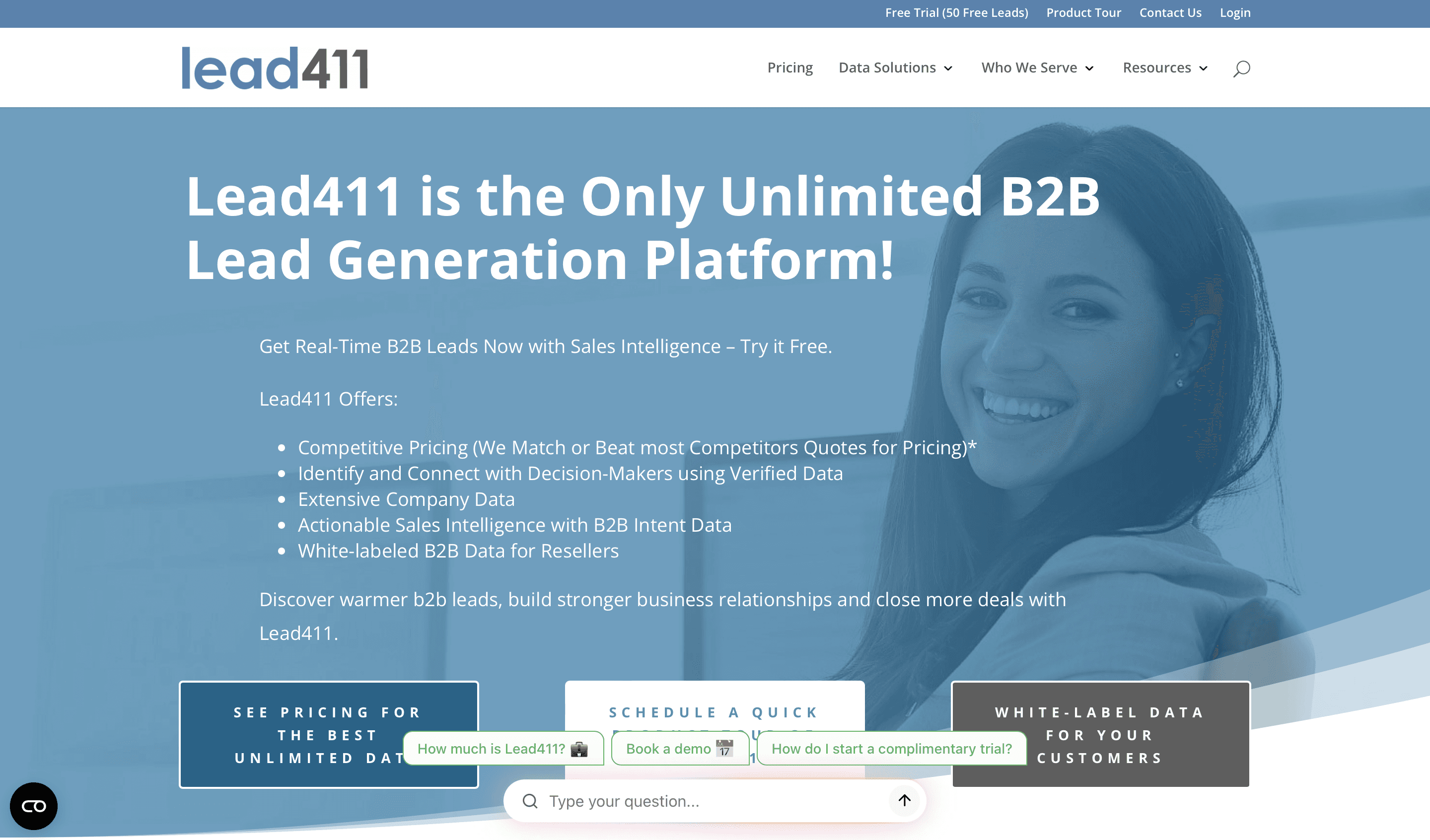
Lead411 is a cost-effective sales intelligence platform offering verified contact data, intent signals, and generous export limits. With built-in outreach tools and flexible pricing, it's a strong alternative for teams looking to reduce costs without sacrificing accuracy or performance. It sits between Apollo and ZoomInfo on both coverage and price, which is exactly the gap most ZoomInfo leavers are trying to fill.
Key Strengths:
Real-time verified emails and direct dials: Contact information refreshed on a regular cycle for accuracy
Growth intent signals: Hiring, funding, tech adoption, and expansion data to identify buying windows
Unlimited exports on the top tier: The Blaze annual plan lifts export caps entirely
Built-in email cadence tool: Native outreach with reply tracking
Native integrations: Works with Salesforce, HubSpot, Outreach, and other major CRMs
Honest limits: Coverage depth is narrower than ZoomInfo's for US enterprise, and international coverage is limited. Single source, so the same blank-row risk applies.
Pricing: Pilot Light free trial, 7 days with 50 exports. Spark $49/month for 1,000 exports, or $490/year for 12,000. Ignite from $150/month, or from $1,500/year. Blaze is quote-based with unlimited annual exports (September 2026).
Ideal for recruiters, marketers and sales teams who want reliable contact data with intent-based signals without the cost or commitment of ZoomInfo.
Clearbit, now HubSpot Breeze Intelligence
Best for: Teams already committed to HubSpot who want enrichment on the record
Clearbit no longer exists as a standalone product. HubSpot acquired it and rebranded it Breeze Intelligence, and in June 2025 the separate Breeze Intelligence credits were folded into HubSpot's single credit pool shared across every Breeze product. If you are evaluating Clearbit as a ZoomInfo alternative today, you are evaluating a HubSpot feature.
Key Strengths:
Real-time enrichment: Automatically enhance data as it enters your systems
Marketing focus: Designed for segmentation and personalization
Form shortening: Fewer form fields by filling company data from the email address
Reveal functionality: Identify anonymous website visitors
Organizations with technical resources that want enrichment embedded in their own systems have historically found the API-first approach valuable, and Clearbit was known for both data quality and developer-friendly APIs, though it takes more implementation work than a UI tool.
Honest limits: Full ecosystem lock-in. No standalone signup, legacy Clearbit APIs deprecated, and credits shared across Breeze Intelligence, Breeze Agents and Copilot, so heavy use of one drains the others.
Pricing: Only inside HubSpot. Seat-based HubSpot subscriptions come with an included credit allowance and you buy more in capacity packs of 1,000. HubSpot documents the packs and the pay-as-you-go overage setting but does not publish a per-credit price on any page we could read, so get the number from your HubSpot rep. Only paid seats can use credits (September 2026). Our full breakdown of Clearbit alternatives covers what to do if you were an API customer.
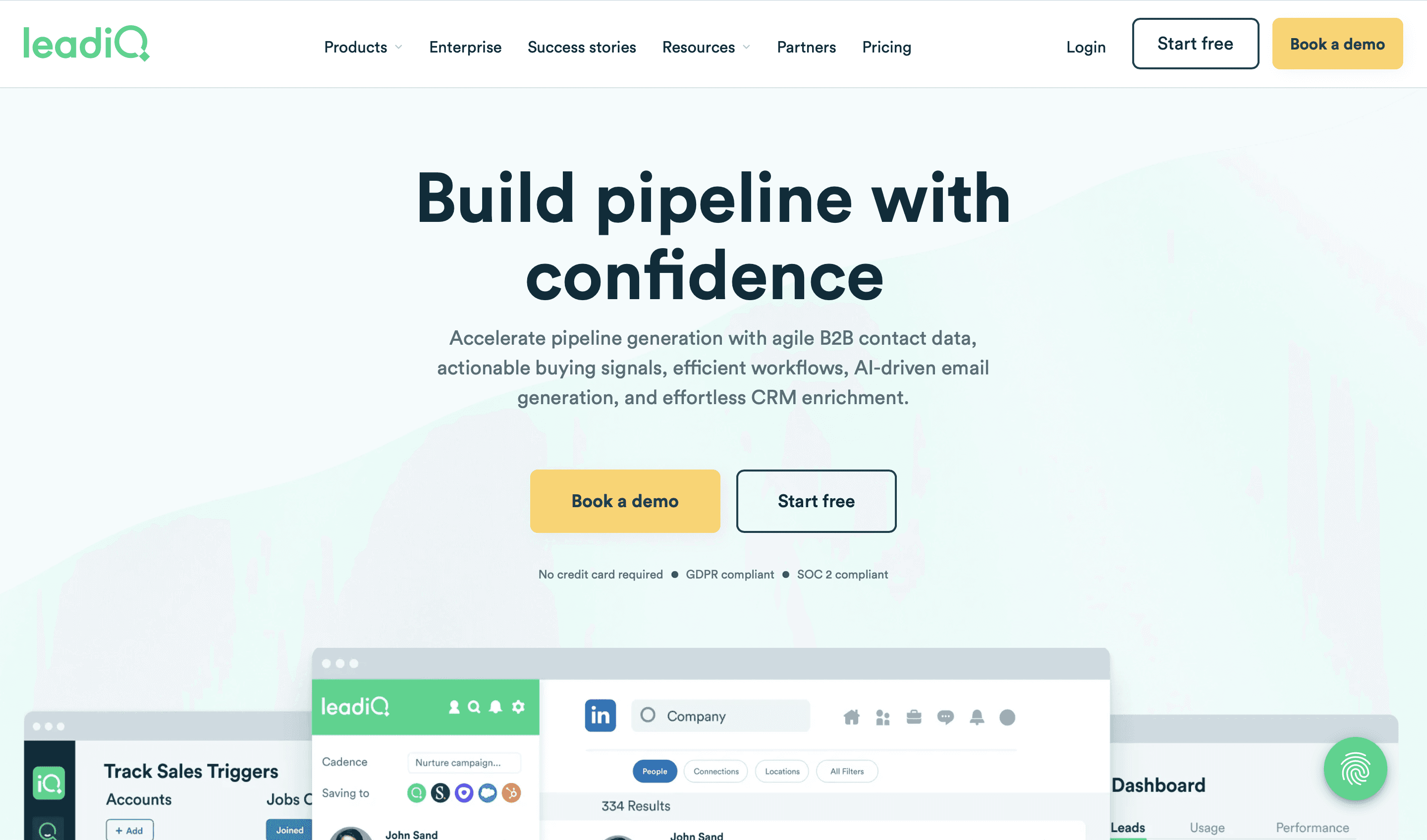
LeadIQ
Best for: SDR teams capturing from LinkedIn straight into Salesforce
LeadIQ focuses on prospecting workflows with a strong emphasis on data accuracy and CRM integration.
Key Strengths:
Chrome extension: Capture prospects while browsing LinkedIn
Data accuracy focus: Emphasis on verified contact information
CRM sync: Strong integration with Salesforce and other major CRMs
Smart recommendations: AI-powered contact suggestions
Sales development teams that live inside LinkedIn tend to find LeadIQ's specialized approach fits their workflow.
Honest limits: The gap between free and Pro is steep, and a phone number costs 10 credits against 1 for an email, so mobile-heavy work burns an allowance quickly.
Pricing: Free plan with 1 user and 50 credits. Pro from $200/month for up to 5 users, with credit tiers stepping from 200 up to 6,750 per month and 25% off on annual billing. Enterprise custom, annual only (September 2026).
Lusha
Best for: Occasional lookups by individual reps
Lusha provides contact information through a browser extension and platform with a credit-based system.
Key Strengths:
Simple interface: Extremely easy to use
Credit-based model: Pay only for what you reveal
Team collaboration: Good sharing capabilities
Browser extension: Quick access while browsing LinkedIn and other sites
For smaller teams that want occasional contact information without committing to a full data platform, Lusha's straightforward approach is appealing. Our roundup of Lusha alternatives covers the tools in the same bracket.
Honest limits: Seat price plus credits means two meters. A phone reveal costs 5 credits against 1 for an email, and that multiplier is what actually drives the bill.
Pricing: 40 credits a month free, an email reveal costing 1 credit and a phone reveal 5. Lusha does not serve its paid seat prices to anything but a browser, so a direct check in September 2026 returned none; take them from the plan picker.
LinkedIn Sales Navigator
Best for: Relationship-led selling, alongside a data provider rather than instead of one
While not strictly a data provider, LinkedIn Sales Navigator offers access to LinkedIn's professional network with specialized search and outreach capabilities.
Key Strengths:
First-party data: Information provided directly by professionals, so it decays more slowly than scraped data
Relationship intelligence: See connections and introduction paths
InMail credits: Direct outreach within the platform
Account targeting: Save accounts and get alerts on changes
Teams that treat LinkedIn as a primary channel and sell on relationships usually run Sales Navigator alongside a dedicated data provider rather than instead of one. If you are weighing the channel itself, see our LinkedIn Sales Navigator alternatives.
Honest limits: No emails, no phone numbers. Sales Navigator tells you who to reach, not how to reach them. It replaces the targeting half of ZoomInfo and none of the contact-data half.
Cognism
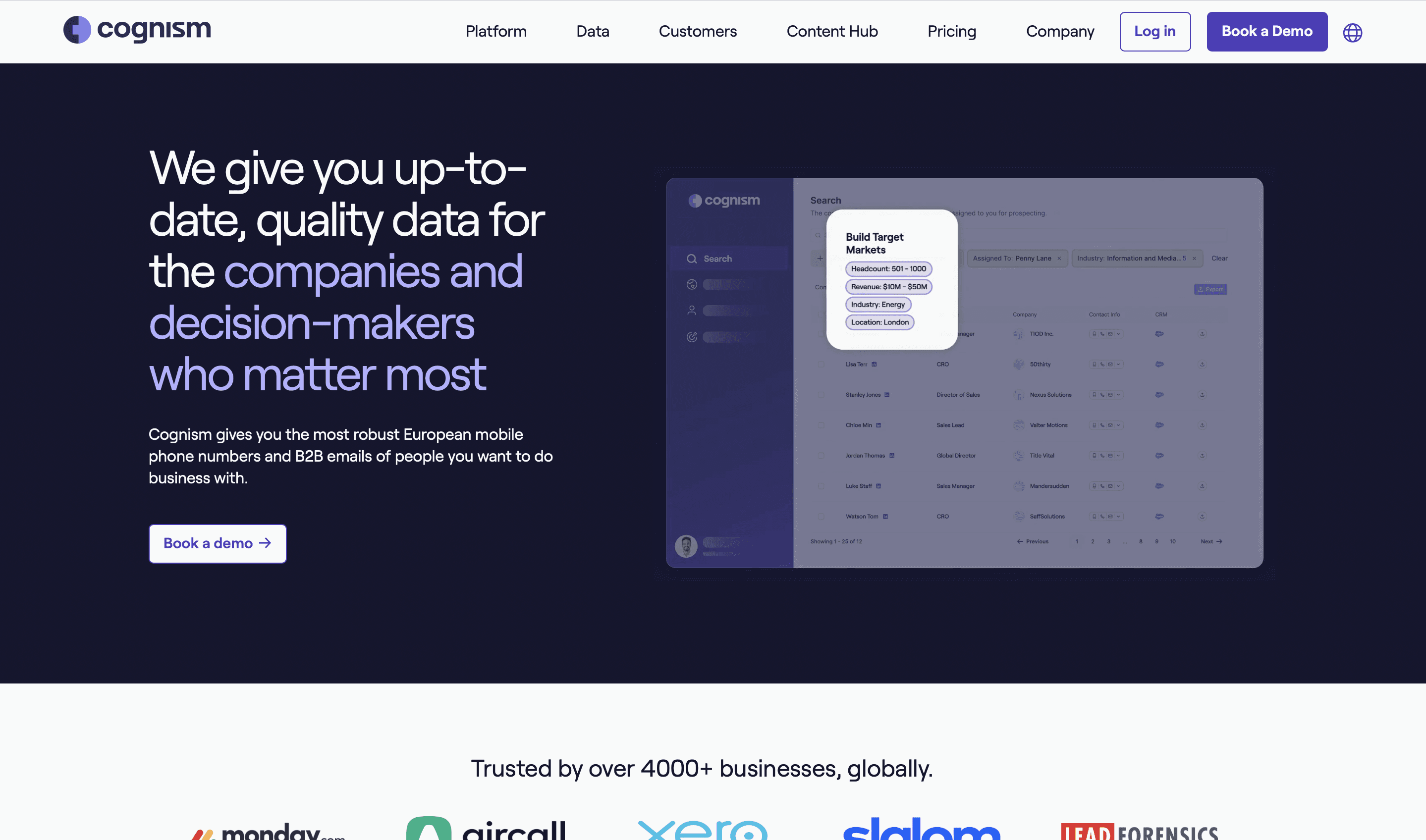
Best for: EMEA-focused teams that need verified mobiles and documented compliance
Cognism specializes in global B2B data with a strong focus on compliance, particularly for European markets. For teams selling primarily into EMEA it often replaces ZoomInfo outright rather than supplementing it.
Key Strengths:
GDPR compliance: Built from the ground up with European data regulations in mind
Global coverage: Strong international data, especially in Europe
Mobile numbers: Manually verified direct dial and mobile phone data
Trigger events: Notifications about key company changes
Organizations with significant European operations tend to find Cognism's compliance-first approach valuable in a complicated regulatory environment. For the wider field, see our Cognism alternatives analysis and the Cognism competitor guide.
Honest limits: The procurement cycle looks a lot like ZoomInfo's, which is a problem if procurement friction is why you are leaving. No free tier, and US coverage is thinner.
Pricing: Quote only. Sales Prospecting comes in Standard and Pro tiers, each including 5 seats, on a model where 1 credit equals 1 revealed contact. CRM Enrichment and Data-as-a-Service are separate add-ons (September 2026).
Seamless.AI
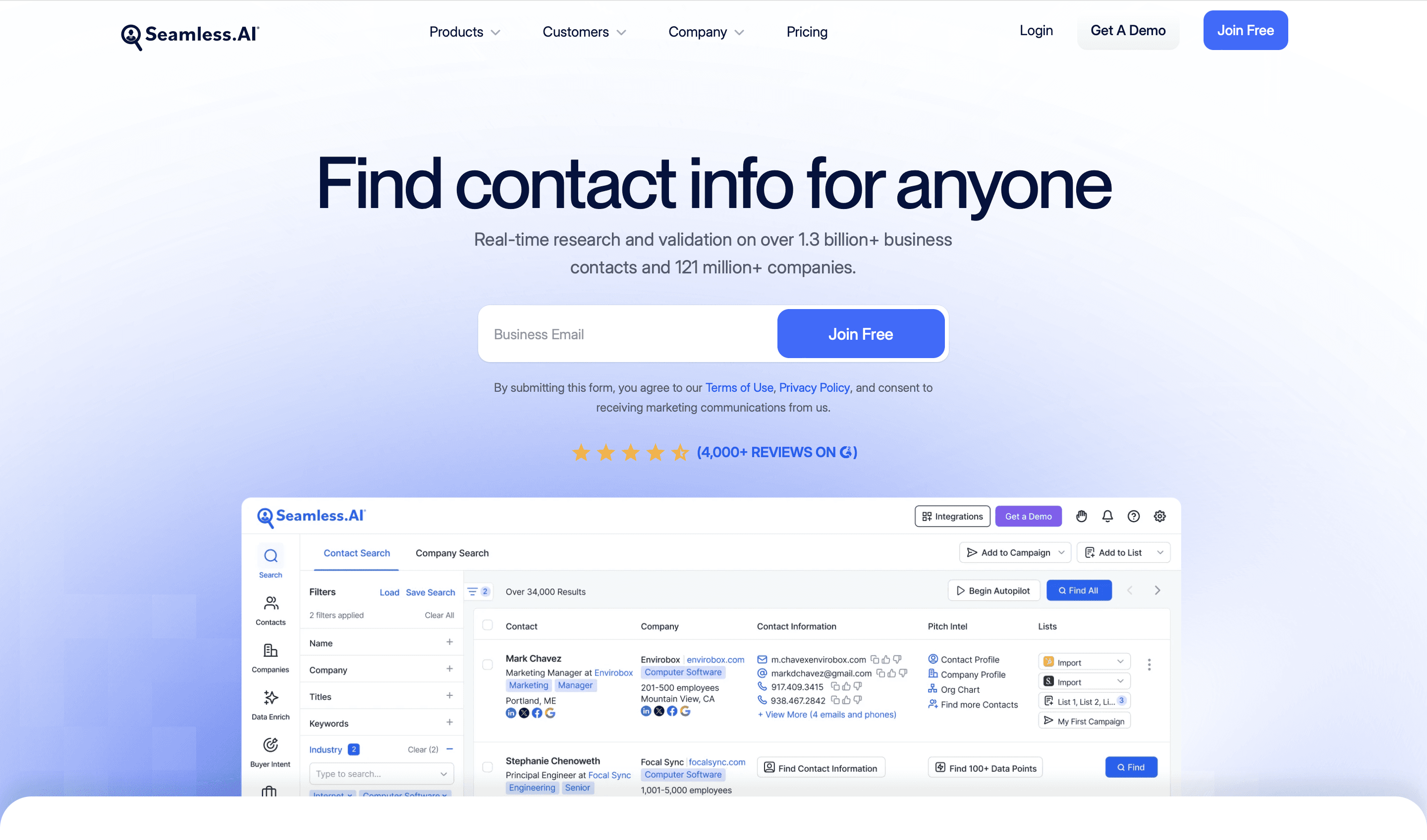
Best for: Teams that want an accuracy guarantee backed by credit replacement
Seamless.AI differentiates itself through its AI-powered approach to real-time contact discovery and verification.
Key Strengths:
On-demand search: Find contacts as you need them rather than paying for database access
AI verification: Continuous checking and updating of contact information
Chrome extension: Quick prospecting while browsing
Team sharing: Collaborative features for sales teams
Teams that value fresh, verified data and prefer searching for specific contacts over bulk database access often find Seamless.AI compelling, and some plans carry no daily or monthly export cap at all.
Honest limits: Paid pricing is quote-only, so if you are leaving ZoomInfo to escape sales calls, this one does not solve that. Single source.
Pricing: Free plan with 1 user and 50 credits. Pro and Enterprise are quote-based, sold as annual credit packages where one credit returns phone plus email (September 2026).
Snov.io
Best for: Tight budgets that still need finding, verifying and sending
Snov.io offers a suite of email-focused prospecting and verification tools at accessible price points.
Key Strengths:
Email finder: Discover professional emails with high accuracy
Drip campaigns: Built-in email outreach capabilities
Verification tools: Validate email addresses before sending
Unlimited seats: Every paid plan includes unlimited team members
Smaller teams on tight budgets that still need reliable email discovery and verification tend to get good value here.
Honest limits: Credits are shared across finding, verifying and sending, so a heavy sending month eats the enrichment budget. No firmographic or intent data.
Pricing: Free renewable trial with 50 credits. Starter $39/month for 1,000 credits, Pro S $99/month for 5,000, Pro M $189/month for 20,000, with 25% off on annual billing (September 2026).
RocketReach
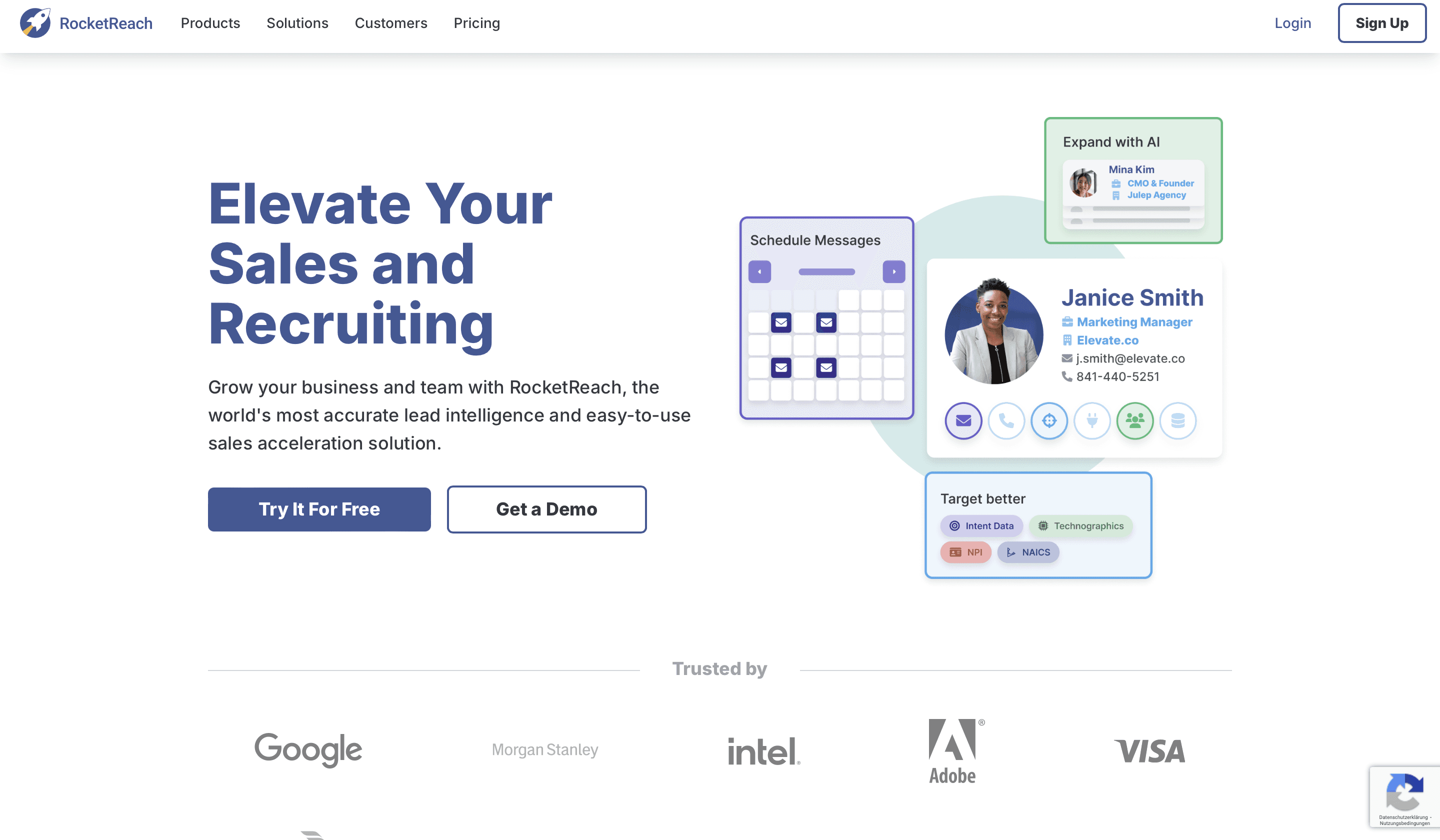
Best for: Phone-first outreach where direct dials matter most
RocketReach focuses on providing contact information for professionals across various industries with emphasis on direct contact methods.
Key Strengths:
Comprehensive profiles: Contact information, social profiles, and work history
Mobile numbers: Strong emphasis on phone data
Chrome extension: Lookup capabilities while browsing LinkedIn and other sites
Bulk lookup: Process multiple contacts simultaneously
Sales teams that prioritize phone outreach and need reliable mobile numbers tend to find RocketReach's dataset worth the money.
Honest limits: Single source, so phone coverage varies sharply by region. A direct check of the RocketReach pricing page in September 2026 returned the page title and no plan figures, so confirm the tiers on the page before you budget.
UpLead
Best for: Low-volume outreach where every bad record costs you
UpLead positions itself as a high-accuracy B2B data provider with real-time verification and global coverage.
Key Strengths:
Real-time verification: Checks email validity at point of export
95% accuracy guarantee: Credits refunded on invalid records
CRM integration: Direct export to major platforms
Technology tracking: Identify companies using specific tools
Teams that want high-accuracy contact data with real-time verification tend to appreciate that UpLead only charges for a valid contact. UpLead is available inside Databar.ai if you would rather not run another subscription.
Honest limits: Credit allowances are slim relative to price, and the plan comparison prices top-up credits at $0.60 each on Essentials and $0.50 on Plus. The database is smaller than Apollo's or ZoomInfo's, so you will hit blank results more often.
Pricing: 7-day free trial with 5 credits. Essentials $99/month, or $74/month billed annually for 2,040 credits per year. Plus $199/month, or $149/month annually for 4,800 credits per year. Professional is custom, annual only (September 2026).
SignalHire
Best for: Targeting engineers across email, phone and social in one record
SignalHire specializes in providing verified contact information across multiple channels with a strong emphasis on technical talent.
Key Strengths:
Multi-channel contacts: Email, phone, and social profiles
Technical talent focus: Strong coverage of engineering and IT professionals
Chrome extension: Source contacts while browsing LinkedIn, GitHub, and other sites
Boolean search: Advanced filtering capabilities
Honest limits: The phone-inclusive plans cost the same monthly as the email-only plan but give roughly a third of the credits, so phone work is effectively triple the price.
Pricing: Free plan with 5 credits, or 10 with the browser extension. $69/month for 1,000 email credits, or $57/month billed annually for 12,000 a year. Phone and combined plans are $69/month for 435 credits, or $57/month annual for 5,400 a year. Scale is quote-based (September 2026).
Comparison: ZoomInfo vs. Top Alternatives
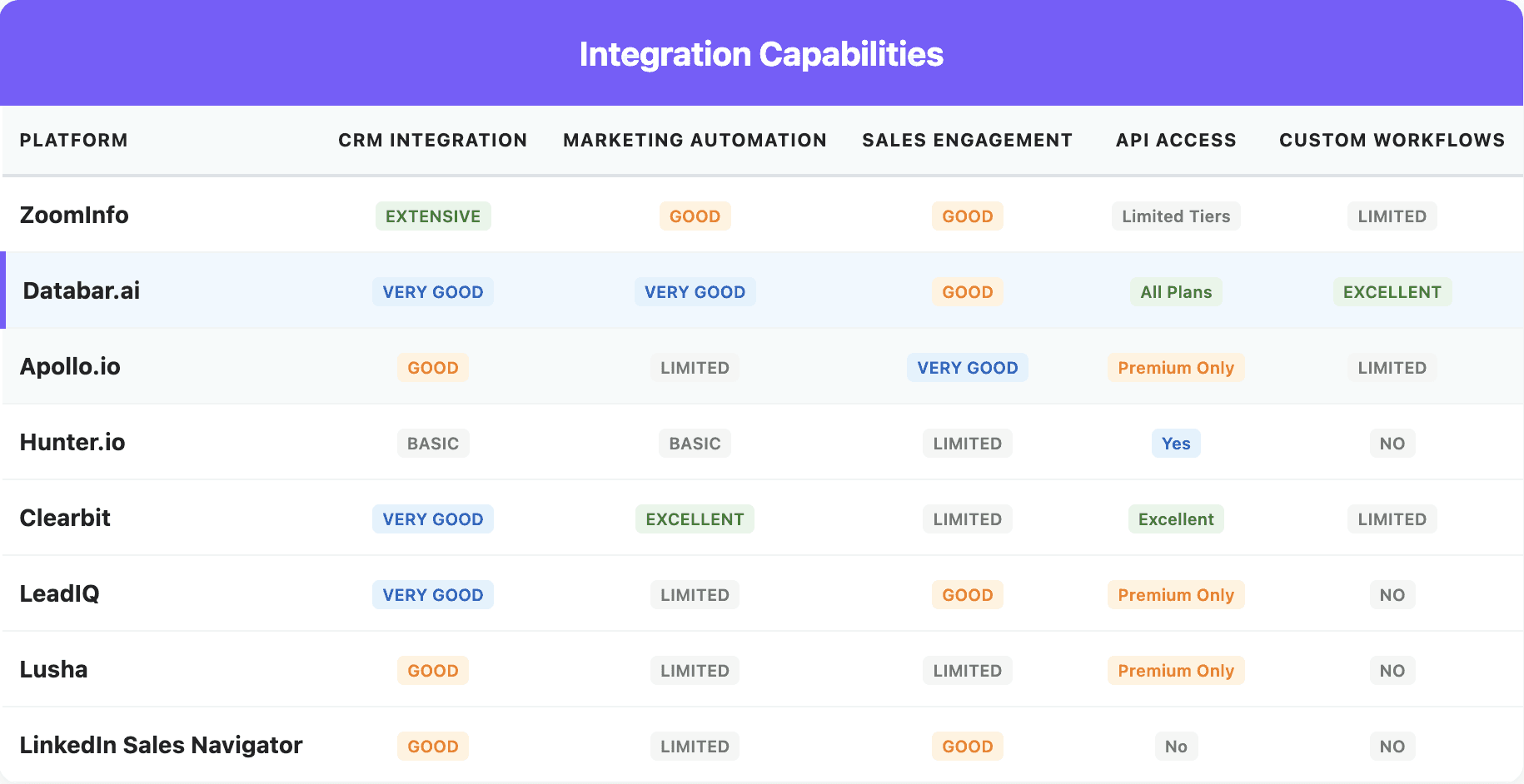
Platform | Coverage model | Self-serve signup | Entry price (Sept 2026) | Intent data |
|---|---|---|---|---|
ZoomInfo | Own database | No, quote and contract | Quote only, median $33,500/year per Vendr | Yes, deepest in category |
Databar.ai | 100+ sources, waterfall | Yes | $99/month | Via provider catalog |
Apollo.io | Own database | Yes | $49/user/month | Yes |
Lead411 | Own database | Yes | $49/month | Yes, growth signals |
Cognism | Own database | No, quote and contract | Quote only | Yes |
UpLead | Own database | Yes | $74/month annual | On higher tiers |
Hunter.io | Own crawl | Yes | EUR 49/month | No |
LeadIQ | Own database | Yes | $200/month | Sales signals |
Lusha | Own database plus partners | Yes | Tiers not published; 1 credit per email, 5 per phone | No |
Snov.io | Multi-tool | Yes | $39/month | No |
Best ZoomInfo Alternatives for Different Use Cases
The ideal ZoomInfo alternative depends heavily on your specific situation and requirements:
For Small Businesses and Startups
Best Options: Databar.ai, Apollo.io, Snov.io
Small businesses need affordable B2B data tools with flexible terms and minimal technical requirements. Unlike enterprise solutions that require significant upfront investments, self-serve alternatives deliver value the same day. Apollo's free Starter plan is a no-cost entry point, though the credit allowance is not published. Snov.io starts at $39/month with unlimited seats. Databar.ai starts at $99/month and charges only when data is returned, which suits irregular usage better than a fixed seat count.
For Mid-Market Companies
Best Options: Databar.ai, Apollo.io, Lead411
If you are rebuilding the stack rather than swapping one tool, our lists of must-have GTM tools and Clay alternatives for data enrichment are the right place to start.
Mid-market organizations need the right balance of data quality, integration capabilities, and cost. Lead411 is the closest thing to ZoomInfo's intent-plus-contacts package at sub-enterprise pricing. Contacts start at $49 a month on Spark, but buyer intent only comes with an annual subscription, from $490 a year for 12,000 exports (September 2026). Apollo provides a unified platform for teams that need both data and outreach. Databar.ai covers the coverage-breadth problem, since it routes across 100+ sources rather than betting on one database. Teams building broader prospecting workflows usually end up with two of these rather than one.
For Enterprise Organizations
Best Options: Cognism, Databar.ai (Enterprise tier), LinkedIn Sales Navigator plus a data provider
Enterprises have requirements around compliance, security, and scale. Cognism is the direct enterprise-grade substitute, particularly for EMEA. Databar.ai's Enterprise tier covers teams that want breadth and programmatic access without a multi-year commit. Many larger organizations use LinkedIn Sales Navigator in tandem with a dedicated data provider, since Sales Navigator handles targeting and the data provider handles contact details.
For Specific Industries
Technology: SignalHire has the strongest coverage of engineering and IT roles, and Apollo has the strongest technographic filtering.
Financial services and healthcare: Cognism's documented compliance frameworks and consent records are what compliance teams ask for.
Manufacturing and industrial: Apollo.io performs well in these sectors with better coverage than some competitors.
International and multi-region: A multi-source aggregator usually beats any single provider here, because it can route to a regional specialist per record instead of applying one dataset everywhere. The mechanics are covered in our waterfall enrichment comparison.
How to Successfully Transition from ZoomInfo
Switching data providers requires careful planning. Follow these steps for a smooth transition:
Audit your current usage: Understand exactly how your team uses ZoomInfo and which features are truly essential
Check your renewal date first: ZoomInfo contracts are annual, and notice periods are real. Work backwards from the renewal so you are not paying twice or stuck for another year.
Run parallel testing: Test your top alternatives alongside ZoomInfo before fully committing
Validate data quality: Compare match rates on a sample of records where you already know the answer, and compare cost per matched record rather than cost per lookup
Plan for integration: Ensure your chosen alternative connects with critical systems
Create a migration timeline: Develop a phased approach to minimize disruption
Provide training: Offer proper onboarding to maximize adoption and effectiveness
Establish new metrics: Set benchmarks to measure the performance of your new solution
Most teams complete this in two to four weeks. Move your highest-volume workflow first and validate it before switching the rest, and keep ZoomInfo for any use case where its depth genuinely wins.
What's Next For B2B Data Solutions
The B2B data landscape continues to evolve rapidly. Here are key trends shaping the future:
AI-driven research: Platforms are investing in AI agents that conduct research beyond simple data lookups
Agent-native access: As GTM workflows move into scripts and AI agents, clean REST surfaces, SDKs and MCP servers matter more than the app's UI
Buyer intent evolution: More sophisticated buying signals based on multi-channel activities
Privacy-first approaches: Growing emphasis on compliant data collection methods
Vertical specialization: Data providers focusing on specific industries with deeper insights
Self-service models: Greater accessibility for teams of all sizes without enterprise sales processes
As these trends accelerate, the advantage increasingly goes to flexible platforms rather than legacy providers with rigid models.
Frequently Asked Questions About ZoomInfo Alternatives
How much does ZoomInfo actually cost?
ZoomInfo does not publish pricing, so every figure in circulation is a third-party estimate. Commonly cited starting prices run $15,000-$20,000 annually, with larger packages above $30,000-$40,000. Procurement platform Vendr reports a median contract value of $33,500 per year across 1,572 ZoomInfo purchases (checked September 2026). Your number depends on seats, feature tier, credit allocation and contract length.
What is the cheapest ZoomInfo alternative?
Snov.io at $39/month for 1,000 credits with unlimited seats, or Apollo's free Starter plan, if the allowance it comes with covers your volume. Lead411 is the cheapest route to intent signals, but only on an annual plan: its own pricing table states that buyer intent and unlimited data come with annual subscriptions, starting at $490 a year for Spark. The $49 monthly plan carries contacts without intent.
Which ZoomInfo alternative is best for Europe?
Cognism. It was built around GDPR compliance and verified mobile data, and its EMEA coverage beats US-headquartered providers in their home regions. For motions spanning several regions, pair it with a multi-source aggregator so records outside its core markets still resolve.
Can one tool replace ZoomInfo?
Sometimes. If your ICP maps cleanly onto Apollo's US mid-market dataset, Apollo can be a straight swap. If you need multi-region coverage or programmatic access, an aggregator replaces it more cleanly because it routes across many providers behind one interface. What no single alternative fully replaces is ZoomInfo's org charts and intent depth at large enterprises.
Is there a free ZoomInfo alternative?
Several tools have free tiers. Apollo runs a free Starter plan without publishing its allowance, Hunter gives 50 credits a month, Lusha 40, LeadIQ and Seamless.AI 50 each, and Snov.io runs a renewable free trial. Databar.ai gives you 14 days on the full product with 100 credits. All are enough to test data quality on contacts you already know. None is enough to run a campaign.
How do I compare data quality between providers fairly?
Build a test list of 100 records where you already know the correct answer, ideally current customers or people you have met. Run it through each candidate. Compare match rate, accuracy of what came back, and cost per matched record. Every vendor measures accuracy on a sample it chose itself, which is why two published figures can both be true and still tell you nothing about each other.
How long does migrating off ZoomInfo take?
Two to four weeks of actual work for most teams, though the contract calendar usually sets the real timeline. Run both tools side by side, compare on a known sample, move the highest-volume workflow first, and validate before switching the rest.
What to Do When the Renewal Lands
While ZoomInfo remains a powerful solution for enterprise use cases, the market now offers ZoomInfo alternatives that provide comparable or better value for many organizations.
For teams seeking the balance of data coverage, usability, and affordability, Databar.ai is a strong option with its multi-source approach, self-serve pricing from $99/month, and outcome-based billing where you only pay when data is successfully returned. Connecting 100+ data sources through one platform removes the coverage ceiling that any single database imposes, without a procurement cycle.
Other alternatives fit differently. Lead411 covers intent at mid-market prices. Cognism owns EMEA. Hunter.io and Snov.io handle narrow email gaps cheaply. LinkedIn Sales Navigator complements all of them.
The key to selecting the right alternative isn't finding a perfect ZoomInfo clone, but identifying which solution aligns most closely with your specific team needs, technical capabilities, and budget requirements.
How Databar.ai Fits Into the Cost-Effective Data Landscape
Here's how our multi-source approach compares against the other options in this guide:
Databar.ai compared to Apollo.io - Multi-source coverage alongside an integrated all-in-one platform
Databar vs Clay - The same enrichment workload priced on both bills
The wider enrichment category - 15 tools compared on coverage model and pricing
Phone number enrichment tools - The same comparison scoped to direct dials and mobiles
Intent data tools compared - If intent signals are the ZoomInfo feature you cannot lose
This approach allows organizations of all sizes to access broad data coverage without the traditional barriers of high costs, complex implementations, or restrictive contracts.
Recent articles
See all