Clearbit no longer exists as a standalone product. HubSpot announced the acquisition on 1 November 2023 and completed it that December. Clearbit's capabilities were relaunched as Breeze Intelligence at INBOUND 2024, the free Logo API was shut down on 1 December 2025, and in June 2025 the separate Breeze Intelligence credits were folded into HubSpot's single credit pool shared across every Breeze product.
That is why most people searching for a Clearbit alternative in 2026 are not shopping on features. They are looking for enrichment that does not live behind a HubSpot subscription, or an API to replace endpoints that were deprecated under them.
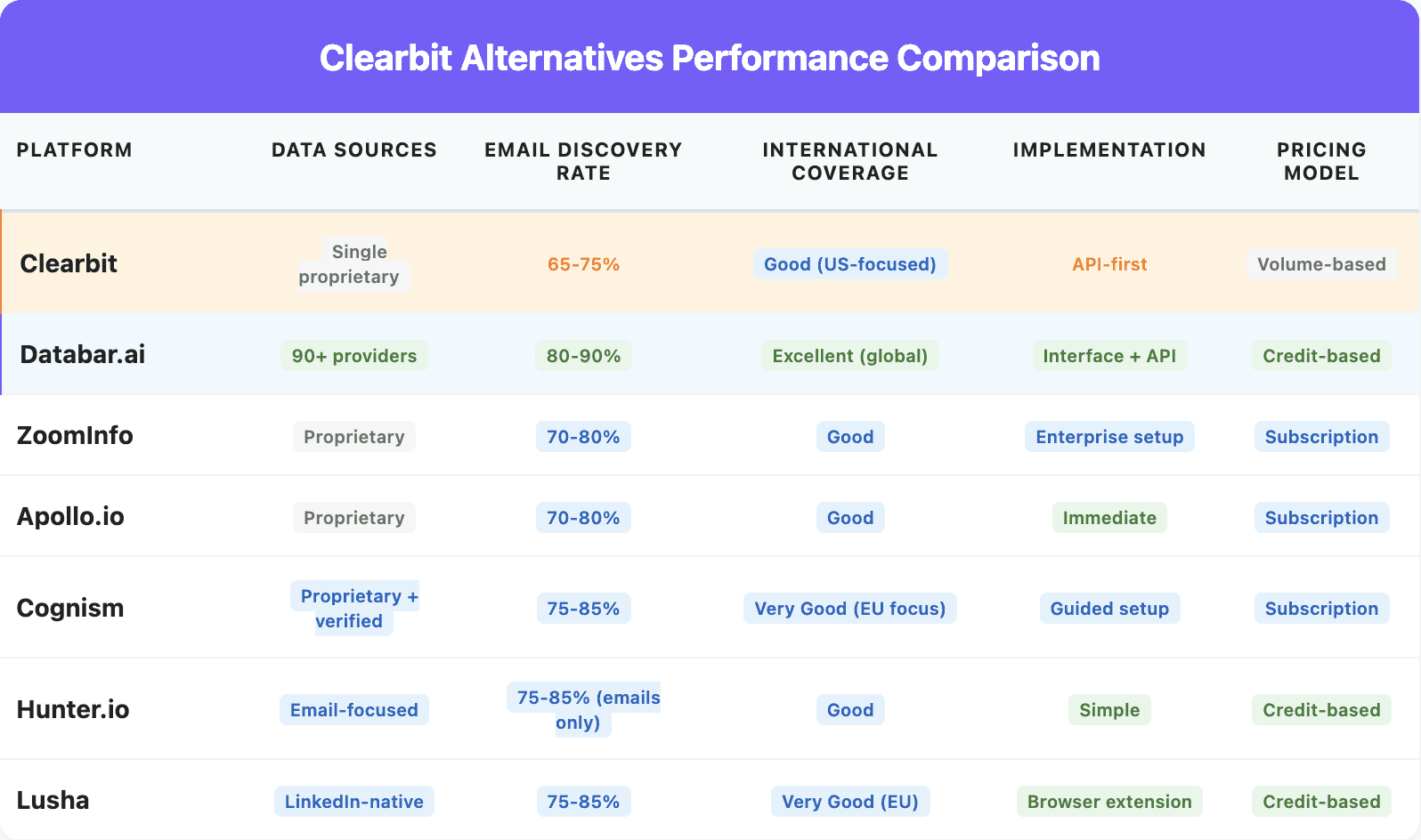
This analysis covers seven platforms that replace what Clearbit used to do, plus two more for teams that built directly on its API. Each brings distinct strengths to different aspects of B2B data enrichment, from multi-source aggregation to specialized compliance frameworks and API integration. Prices come from each vendor's own page, read in September 2026; where a vendor does not publish one, we say so rather than repeat a third-party figure.
Where Clearbit Customers Have Landed
Platform | Best for | Coverage model | Entry price (Sept 2026) | Free tier |
|---|---|---|---|---|
Databar.ai | Multi-source enrichment with no CRM lock-in | 100+ data sources, waterfall | $99/month, 5,000 credits | Yes, plus 14-day trial |
ZoomInfo | Enterprise depth, intent and org charts | Own database | Quote only | No |
Apollo.io | Data plus sequencing in one platform | Own database | $49/user/month | Free Starter plan, allowance not published |
Cognism | GDPR-compliant EMEA mobile and email | Own database | Quote only, 5 seats | No |
Hunter.io | Email discovery and verification | Own crawl | EUR 49/month, 2,000 credits | 50 credits/month |
Lusha | LinkedIn-native rep lookups | Own database plus partners | Paid tiers not published; 1 credit per email, 5 per phone | 40 credits/month |
UpLead | Accuracy guarantee on a smaller database | Own database | $74/month billed annually | 7-day trial, 5 credits |
What Actually Happened to Clearbit
The timeline matters, because which part of Clearbit you were using determines which alternative fits.
November 2023: HubSpot announces a definitive agreement to acquire Clearbit. Clearbit's own sunset notice dates the completed acquisition to December 2023.
September 2024: Clearbit's capabilities relaunch as Breeze Intelligence at INBOUND, inside HubSpot rather than alongside it.
June 2025: Breeze Intelligence credits transition into HubSpot Credits, a single pool shared with Breeze Agents and Copilot.
1 December 2025: the free Clearbit Logo API shuts down. Clearbit's own post on the future of its free tools sets the date and the Logo API page now points developers at logo.dev instead.
Three practical consequences follow. There is no standalone signup. Breeze Intelligence is usable only on a paid HubSpot seat, since free and view-only seats cannot spend HubSpot Credits at all. And because every Breeze product draws from the same pool, heavy use of one eats the budget for the others.
The lesson underneath all of this is vendor independence. A platform that only works inside one CRM ties your enrichment roadmap to that vendor's product decisions, and Clearbit's API customers found out what that costs. Weigh it before you pick the replacement.
If you were an API customer, you need a data provider with a stable API, not a CRM feature. If you used Reveal to identify anonymous website traffic, you need a visitor-identification tool. If you used Clearbit for form shortening, that capability now only exists inside HubSpot. Each of those is a different shortlist. If yours is email finding, our roundups of SignalHire alternatives and email finder tools and Dropcontact alternatives cover that ground, and Lusha alternatives covers contact finding specifically.
Evolving B2B Data Enrichment Options
The data enrichment market has matured into distinct segments, each addressing specific business needs and implementation preferences. Understanding these dynamics helps identify which platforms complement existing strategies or provide alternative approaches to B2B intelligence gathering.
Technical implementation preferences have created two primary market segments. API-first platforms, as Clearbit was, excel for organizations with strong technical capabilities who need deep system integration and real-time data enrichment through API integration. Interface-first platforms serve teams requiring immediate access through web applications and browser extensions, enabling deployment without technical overhead.
Data sourcing methodologies represent another key differentiation. Single-source providers maintain proprietary databases with consistent data standards and quality controls. Multi-source aggregators combine data from numerous providers through waterfall enrichment approaches to maximize coverage and accuracy. The practical gap is large: on the lists we run, one provider lands in the 50s or low 60s and a cascade across several complementary sources lands in the 80s. Those are ranges we observe rather than a published benchmark, and they move with region and seniority.
Geographic and industry specialization has become increasingly important as sales teams target specific markets. Some platforms excel in North American coverage, others provide superior international data, and specialized providers focus on particular industries or professional networks.
API integration complexity requirements vary significantly between organizations. Enterprise teams with mature tech stacks often prefer sophisticated API capabilities that embed data enrichment directly into existing workflows. In 2026 that increasingly means agent-native surfaces too, since a growing share of enrichment is called by a script or an AI agent rather than by a person. Our guide to choosing between MCP, an SDK and a plain API covers when each one matters.
Compliance and privacy frameworks have emerged as critical selection criteria for global organizations. Platforms specializing in GDPR compliance, consent management, and regional data handling serve organizations operating across multiple jurisdictions with varying regulatory requirements.
The most effective data enrichment strategies use the strengths of different platforms for specific use cases rather than seeking universal solutions. Understanding these distinct approaches enables more strategic technology investments.
Strategic Framework: Evaluating Data Enrichment Platforms
Before examining specific alternatives, establishing clear evaluation criteria helps identify which platforms deliver the capabilities your team needs while aligning with operational requirements and strategic objectives.
Implementation and Integration Approach
Technical Resource Requirements significantly impact platform selection and time-to-value. API-first solutions provide maximum flexibility and customization but require development resources for optimal implementation. Interface-first platforms offer immediate functionality through web applications and browser extensions, enabling teams to begin prospecting within minutes.
Workflow Integration Philosophy affects long-term adoption and efficiency. Some platforms enhance existing processes through CRM integration and familiar user interfaces. Others provide standalone environments that may require teams to adopt new primary workflows for prospect research and data enrichment.
Scalability and Flexibility considerations impact growth planning. Enterprise-focused platforms often include sophisticated customization options but require substantial commitments. Growth-stage solutions typically offer more flexible scaling that aligns with team expansion and evolving requirements.
Data Coverage and Quality Standards
Source Diversity and Verification approaches influence data accuracy and coverage. Single-source providers maintain consistent quality standards through proprietary collection methodologies. Multi-source aggregators access broader data pools while implementing contact verification processes to ensure reliability.
Geographic and Industry Specialization affects targeting precision. Global platforms provide broad coverage but may have gaps in specific regions or professional networks. Specialized providers often deliver superior accuracy in their focus areas while having limitations elsewhere.
Data Freshness and Update Frequency impact campaign effectiveness. Real-time enrichment provides current information but typically costs more per record. Batch processing offers cost efficiency for large-scale prospecting while requiring planning around update cycles.
Business Model and Cost Structure
Pricing Model Alignment affects budget predictability and cost efficiency. Subscription-based platforms provide stable monthly costs but may include unused capacity. Credit-based systems offer usage flexibility but require monitoring to prevent budget overruns. Outcome-based billing, where you only pay when data is successfully returned, removes the cost of failed lookups entirely, which matters most for automated workloads that retry.
Total Cost of Ownership includes implementation expenses, training requirements, and ongoing maintenance. Simple platforms may carry a higher per-record cost but a lower total investment, while sophisticated ones offer better unit economics and demand a substantial setup investment. On top of that, the number that decides it is cost per matched record, not cost per lookup. A nickel lookup that finds the person 55% of the time costs $0.09 for every record you can use; a ten-cent cascade that finds them 85% of the time costs $0.12, and leaves you holding 55% more usable records from the same list.
Top 7 Clearbit Alternatives: Strategic Analysis
The opportunity: Modern revenue teams are discovering that Clearbit alternatives often provide superior results for specific use cases, whether that is simplified implementation, enhanced international coverage, or integrated sales engagement capabilities. Rather than viewing these as replacements, successful organizations are evaluating which platform best aligns with their own requirements for contact verification, data sourcing, and technical implementation.
1. Databar.ai: The Multi-Source Intelligence Platform
Best for: Teams that want breadth and no CRM lock-in
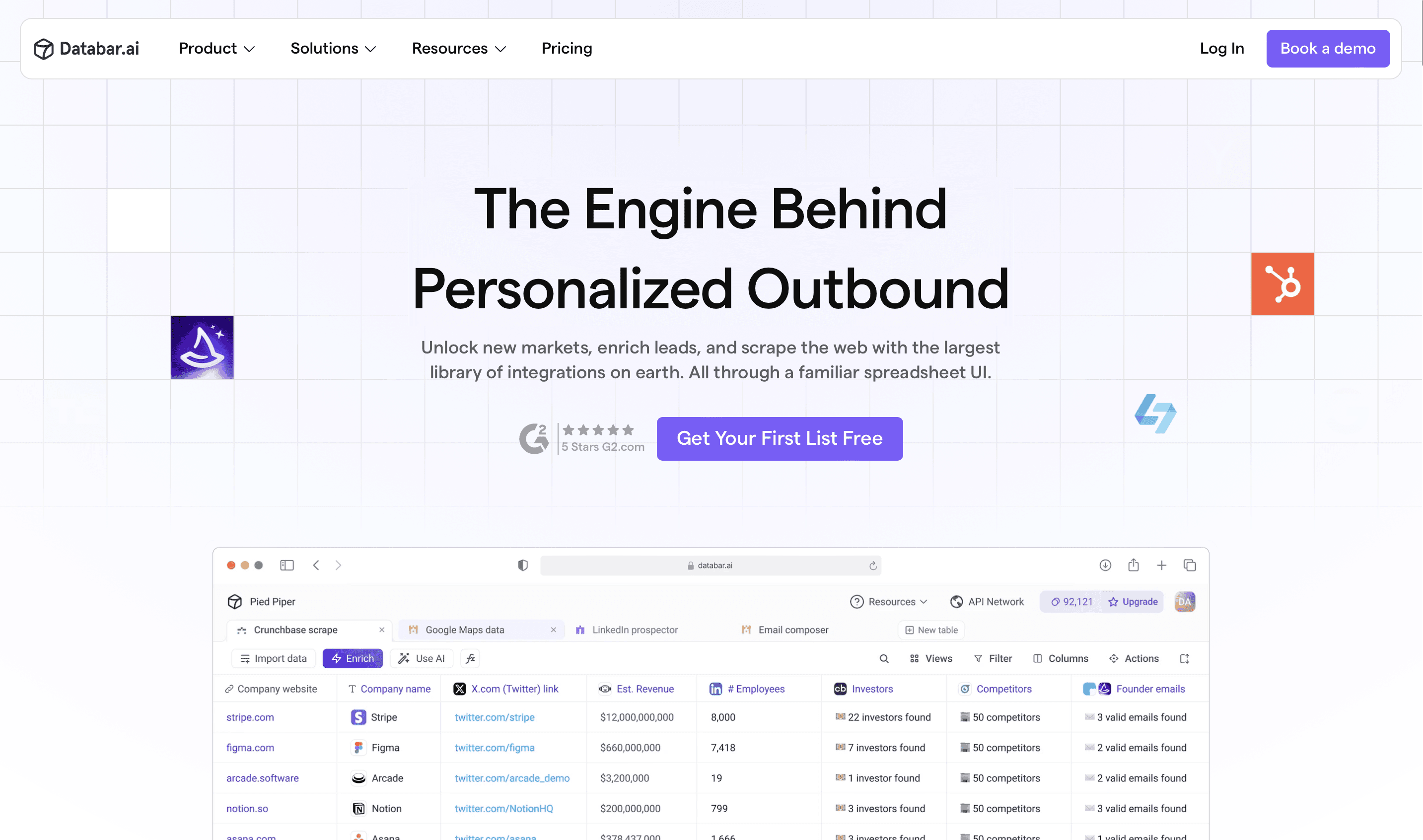
Databar.ai provides access to 100+ data sources and 160+ integrations through a unified interface. This addresses the complexity of managing multiple vendor relationships while maximizing coverage across industries and geographic markets. The direct contrast with what happened to Clearbit is independence: Databar works with HubSpot, Salesforce, Attio or any CRM through its REST API, Python SDK, CLI or hosted MCP server, rather than living inside one of them.
Strategic Positioning:
Primary Market: GTM, sales and marketing teams requiring diverse data sources and automation
Core Value Proposition: Broad data coverage through multi-source aggregation, with outcome-based billing so you only pay when data is successfully returned
Competitive Advantage: Source diversity and workflow flexibility, plus AI agents for research, classification and personalization
Key Differentiators: Databar's multi-source architecture queries several data providers to maximize contact discovery. This waterfall approach typically achieves 80-90% email discovery compared to 40-50% from single-provider platforms, which shows up directly in how much of a list you can actually work.
The platform's AI research agent extends beyond basic contact lookup to extract insights from websites, social profiles, and business publications. That capability matters most for emerging companies or specialized industries that traditional databases do not cover.
Workflows are built without code. GTM teams can create enrichment sequences that combine multiple sources, apply validation rules, and route results based on prospect characteristics, then run the same sequences programmatically when a script or an agent is the consumer.
Transparent credit-based pricing provides cost predictability while avoiding the large minimum commitments typical of enterprise platforms. You pay for successful data enrichment rather than for seats that may sit unused.
Best Use Cases:
Teams that want data from multiple providers through enrichment platforms without multiple subscriptions
Organizations requiring specialized regional data coverage
Teams targeting niche industries with specific data requirements
Sales operations building custom prospecting workflows
Former Clearbit API customers who want an enrichment API that is not tied to a CRM
Honest limits: Databar is not a prospecting database, so you cannot search by title and industry to build a list from scratch. There is no form shortening and no native website visitor identification, so it does not replace Clearbit's Reveal product directly. Picking providers from a 100-source catalog takes a session to get right.
Pricing: Self-serve at $99/month for 5,000 credits on Build, or $495/month for 50,000 on Scale, with Enterprise quoted. You get 14 days on the whole product and 100 credits before any card is charged. Every workspace starts with 100 free trial credits (September 2026).
Implementation Considerations: Databar offers guided setup that delivers value within hours. It suits organizations that treat data enrichment as a strategic capability and want a flexible, evolving, automated approach rather than a fixed one. Browse the provider catalog to see what you would actually be buying.
See Databar.ai plans and start the trial.
2. ZoomInfo: The Enterprise Data Intelligence Leader
Best for: Enterprise teams that need org charts and intent at scale
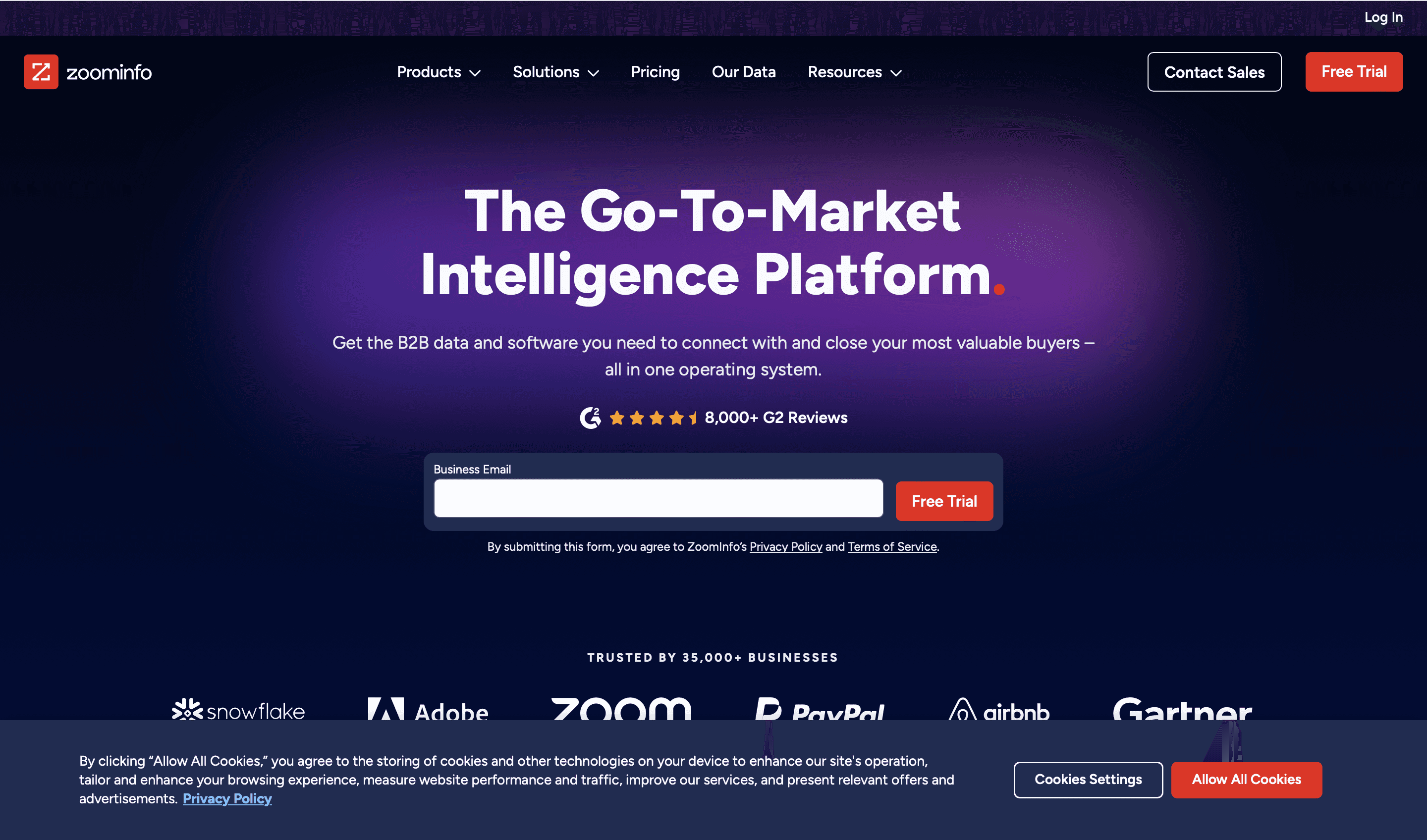
ZoomInfo offers extensive databases with sophisticated organizational mapping and intent data capabilities that serve enterprise sales strategies requiring deep account insights.
Strategic Positioning:
Primary Market: Large enterprises requiring comprehensive B2B contact and company intelligence
Core Value Proposition: Database depth with advanced intent signals and organizational mapping
Competitive Advantage: Data breadth and enterprise-grade features for complex sales strategies
Key Differentiators: ZoomInfo's proprietary database contains verified information on over 100 million professionals and 14 million companies, with particularly strong coverage in North American markets. The platform's data collection methodology combines web crawling, email signatures, and user-contributed information with robust contact verification.
Intent data identifies companies actively researching relevant solutions through content consumption tracking across business publications. Organizational mapping provides company hierarchies showing reporting relationships and decision-making structures. Technographic intelligence reveals technology stacks used by target companies.
Best Use Cases:
Enterprise sales teams requiring organizational intelligence
Account-based marketing strategies targeting large organizations
Technology vendors needing detailed technographic insights
Honest limits: Procurement-heavy, annual contracts, no self-serve entry. Coverage thins outside US enterprise, and the API is a secondary surface behind the app. For a former Clearbit API customer this is close to the opposite of what you had.
Pricing: Quote only. ZoomInfo does not publish rates. As a public benchmark, procurement platform Vendr reports a median contract value of $33,500 per year across 1,572 ZoomInfo purchases (September 2026). Our ZoomInfo alternatives guide covers the cheaper end of this category in detail.
3. Apollo.io: The Integrated Sales Intelligence Platform
Best for: Teams that need enrichment and outbound sending in one subscription
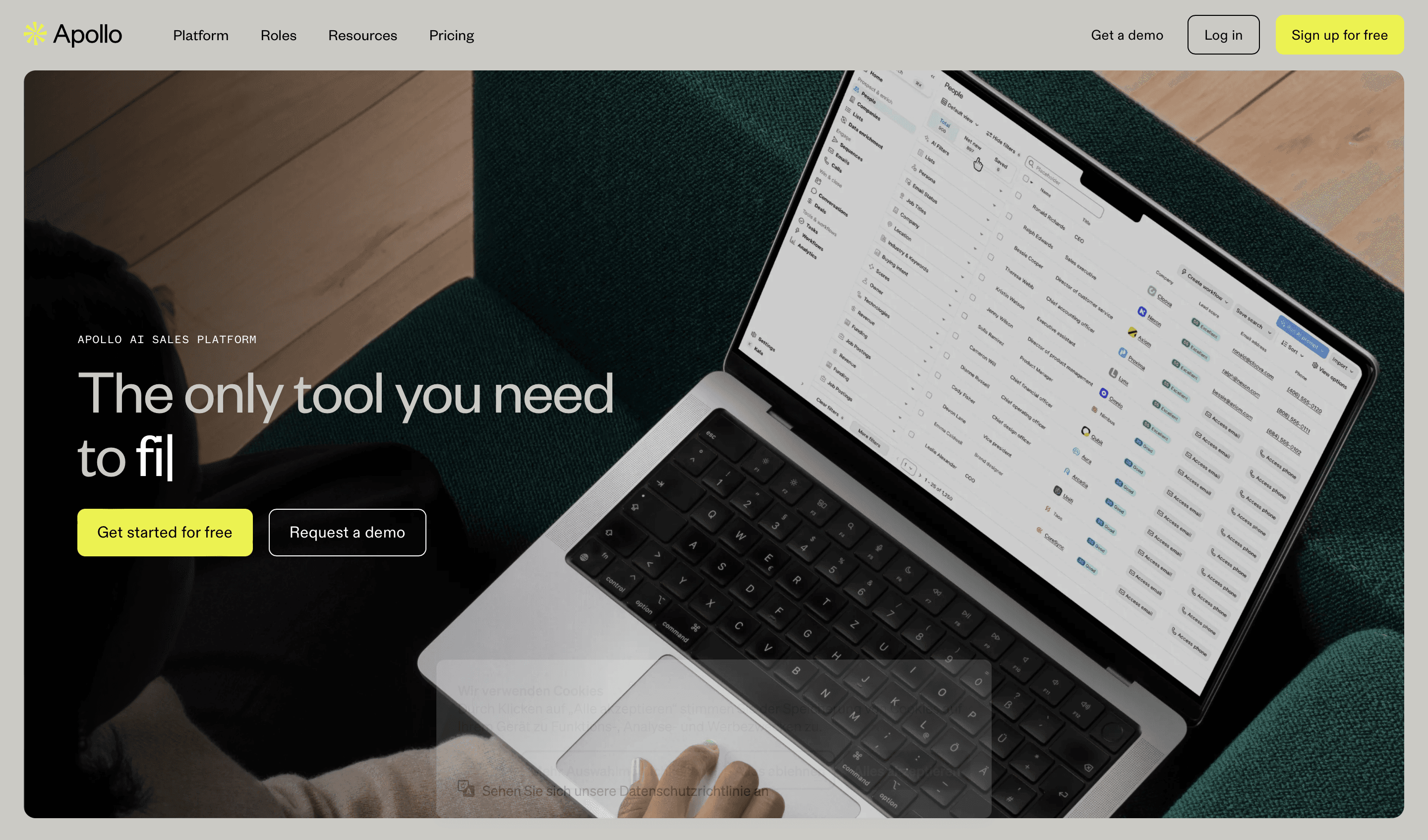
Apollo.io combines B2B data enrichment with native sales engagement, providing a unified platform that removes the need for separate data and outreach tools.
Strategic Positioning:
Primary Market: Sales teams seeking combined data access and engagement capabilities
Core Value Proposition: Unified platform removing separate data and outreach tool requirements
Competitive Advantage: Integrated engagement functionality with database access
Key Differentiators: Apollo's combined approach enables workflows from prospect identification through engagement execution. Teams research contacts, verify email addresses, and launch personalized sequences without transferring data between platforms. The proprietary database includes over 275 million contacts with strong technographic coverage, which makes it valuable for software vendors and teams selling to technical audiences.
Native email sequencing provides automation including A/B testing, dynamic personalization, and engagement tracking. The Chrome extension enables prospect research while browsing LinkedIn or company websites.
Best Use Cases:
Small to mid-size sales teams seeking unified data and engagement tools
Organizations wanting to consolidate vendor relationships
Technology vendors requiring strong technographic intelligence
Honest limits: Single-source coverage, so a miss means a blank row with no fallback. International coverage is thinner than US coverage, and API rate limits scale with seat tier, which throttles batch work.
Pricing: A free Starter plan, Basic at $49 per user per month and Professional at $99 per user per month, with Enterprise quoted. The plan table on apollo.io/pricing is rendered in the browser, so those figures come from the structured data the page publishes about itself, and the credit allowance per tier is not published at all (September 2026). Ask Apollo for the allowance before you swap a Clearbit API budget for a seat budget.
➔ See how Apollo.io compares against its alternatives.
4. Cognism: The Compliance-Focused Global Data Provider
Best for: Teams selling into EMEA with a compliance team to satisfy
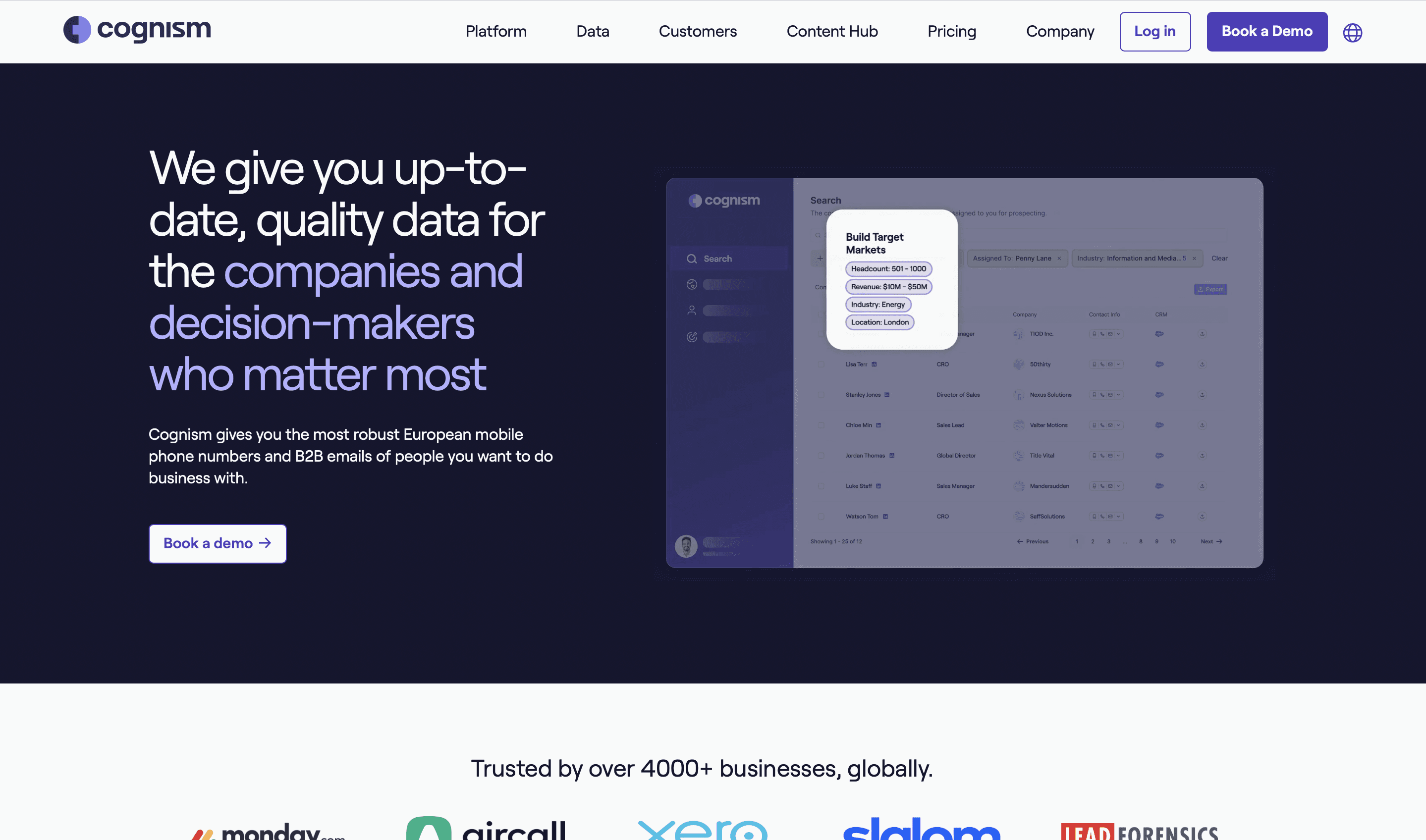
Cognism is a leading choice for organizations requiring verified, compliant B2B data enrichment with particular strength in European markets.
Strategic Positioning:
Primary Market: Global enterprises with European operations requiring GDPR-compliant data
Core Value Proposition: Verified, compliant global data with superior European coverage
Competitive Advantage: Regulatory compliance expertise and international data quality
Key Differentiators: Cognism's compliance-first architecture handles data collection and processing against GDPR requirements through documented consent mechanisms and regular auditing. Diamond Data verification includes manually verified mobile phone numbers, where human verification teams confirm details through multiple touchpoints, which lifts connection rates on outbound calling.
European coverage is built through specialized collection targeting European business networks. Real-time compliance monitoring tracks data usage permissions and consent status, so compliance teams get audit trails rather than assurances.
Best Use Cases:
Global enterprises with significant European operations
Organizations in regulated industries requiring compliance documentation
Teams prioritizing direct phone outreach with verified mobile numbers
Honest limits: US coverage is thinner than ZoomInfo's, there is no free tier, and the procurement cycle looks like an enterprise purchase rather than a signup.
Pricing: Quote only. Sales Prospecting comes in Standard and Pro tiers, each including 5 seats, on a model where 1 credit equals 1 revealed contact. CRM Enrichment and Data-as-a-Service are separate add-ons (September 2026).
5. Hunter.io: The Email Discovery Specialist
Best for: Teams whose Clearbit use was mostly email lookups
Hunter.io focuses exclusively on email discovery and verification, providing a straightforward solution for teams primarily needing reliable email addresses with simple implementation and transparent pricing.
Strategic Positioning:
Primary Market: Teams focused primarily on email outreach requiring reliable email discovery
Core Value Proposition: Specialized email finding and verification with usage-based pricing
Competitive Advantage: Email specialization and implementation simplicity
Key Differentiators: Hunter's domain-based search identifies email patterns within organizations and applies machine learning to generate probable addresses with confidence scoring. That approach often surfaces contacts not available through traditional database providers. Real-time verification checks deliverability using SMTP verification, domain validation, and historical bounce tracking.
The API is simple enough to embed into an existing workflow without an enterprise platform underneath it, which makes Hunter one of the least painful migrations for a former Clearbit developer whose use case was narrow.
Best Use Cases:
Teams prioritizing email outreach over other communication channels
Organizations needing simple integration with existing tools
Small businesses requiring cost-effective contact discovery
Honest limits: Email only. No phone numbers, no firmographics, no intent, no visitor identification. Coverage depends on what is publicly indexed.
You can also run Hunter.io natively inside Databar.ai if you would rather not carry another subscription.
Pricing: Free plan with 50 credits per month. Starter EUR 49/month for 2,000 credits, Growth EUR 149/month for 10,000, Scale EUR 299/month for 25,000, with about 30% off on annual billing. Unlimited team members on every plan. Hunter prices in euros (September 2026).
6. Lusha: The LinkedIn-Native Contact Intelligence Platform
Best for: Reps who prospect inside LinkedIn and want one-click reveals
Lusha specializes in contact discovery directly within LinkedIn and Sales Navigator, with strong European market coverage and GDPR compliance.
Strategic Positioning:
Primary Market: Sales professionals practicing LinkedIn-based social selling
Core Value Proposition: Verified contact discovery directly within LinkedIn with compliance
Competitive Advantage: Native LinkedIn integration and European market specialization
Key Differentiators: Lusha's LinkedIn extension provides contact discovery without leaving a profile or a Sales Navigator search, removing the context switch between prospecting and enrichment. European coverage includes verified mobile numbers and email addresses in markets where many platforms have limited availability. Team collaboration features enable contact sharing and usage tracking with management visibility into credit consumption.
Best Use Cases:
Sales professionals focused primarily on LinkedIn prospecting
Teams requiring GDPR-compliant contact discovery
Organizations with significant European market exposure
Honest limits: Seat price plus per-reveal credits means two meters, and a phone reveal costs 5 credits against 1 for an email. Extension-first design makes it a poor replacement for an API-driven Clearbit workflow.
Pricing: The free plan carries up to 40 credits a month; an email reveal costs 1 credit and a phone reveal 5. Lusha's paid tiers render client-side and returned nothing to a direct check in September 2026, so price the seats on the page itself.
7. UpLead: The Accuracy-Guaranteed Data Provider
Best for: Low-volume outreach where every bad record costs you
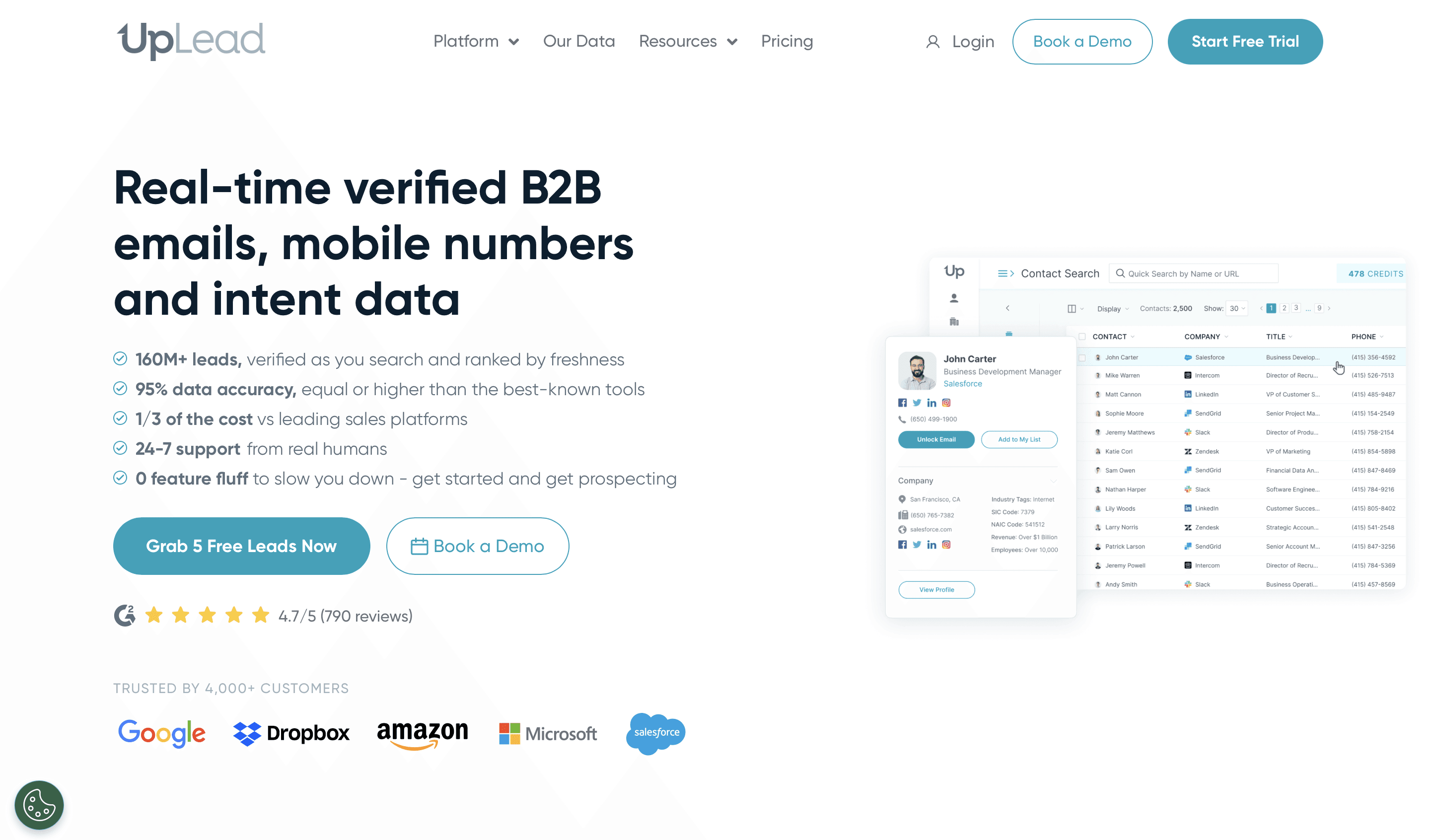
UpLead differentiates itself through accuracy guarantees and real-time verification, emphasizing data reliability over database breadth.
Strategic Positioning:
Primary Market: Teams prioritizing data accuracy over database size
Core Value Proposition: 95% accuracy guarantee with real-time verification
Competitive Advantage: Accuracy guarantee and quality focus
Key Differentiators: UpLead's 95% accuracy guarantee backs contact information with replacement credits for invalid data. Real-time verification confirms details during enrichment using multiple validation techniques, with confidence scores and verification status for prioritization. Advanced filtering enables precise targeting through over 50 search criteria including technology usage, company growth indicators, and recent business events.
Best Use Cases:
Teams where contact accuracy directly impacts revenue outcomes
Organizations with limited outreach capacity requiring high-quality prospects
Companies seeking predictable data costs through credit-based consumption
Honest limits: Credit allowances are slim for the price, the plan comparison prices top-ups at $0.60 a credit on Essentials and $0.50 on Plus, and the database is smaller than Apollo's or ZoomInfo's, so blank results are more common.
Pricing: 7-day free trial with 5 credits. Essentials $99/month, or $74/month billed annually for 2,040 credits per year. Plus $199/month, or $149/month annually for 4,800 credits per year. Professional is custom, annual only (September 2026).
UpLead is also available inside Databar.ai, which is the cheaper way to test it against your own list before committing to a plan.
Two More Options for Specific Clearbit Use Cases
Not everything Clearbit did maps onto a general enrichment platform. Two gaps are worth naming.
People Data Labs, if you built on Clearbit's API. PDL is the closest technical analogue: an API-only data provider with no UI, no CRM and no workflow builder, just person, company and IP enrichment endpoints behind documented REST. Enrichment credits are consumed per successful match, so a request that returns nothing does not cost a credit. The free plan grants a small monthly credit allowance with email, phone and address data obfuscated, and paid usage is volume-based with a discount for annual commitment. PDL does not publish a simple list price, so get a quote rather than budgeting from a third-party figure.
LeadMagic, if you used Clearbit Reveal. Website visitor identification is the one Clearbit product that does not have an obvious successor on this list. LeadMagic pairs visitor identification with email finding at published prices: Basic $49.99/month for 2,000 credits, Essential $99/month for 5,000, Growth $249/month for 20,000, with annual billing at ten times the monthly rate. It is a newer platform with a smaller user base, no waterfall, and no native CRM integrations, so plan for Zapier or custom API work to get data into your CRM.
Pricing Analysis: Understanding Cost Structures
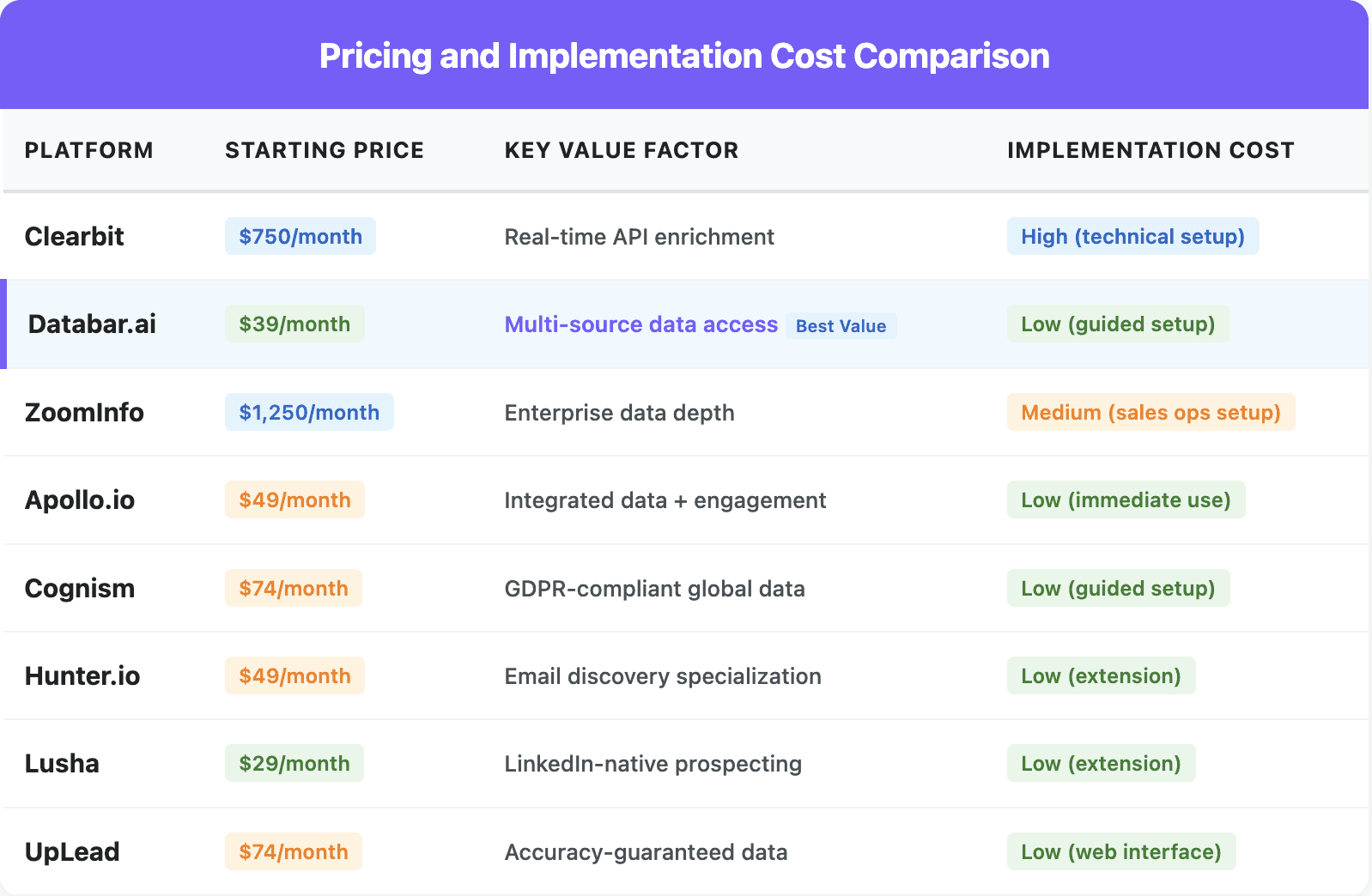
Understanding the investment required for different data enrichment platforms helps teams make informed budget decisions while considering total value delivery rather than just monthly costs.
Platform | Pricing model | Entry price (Sept 2026) | What a miss costs you | Self-serve signup |
|---|---|---|---|---|
Breeze Intelligence (ex-Clearbit) | HubSpot Credits | Capacity packs of 1,000 credits, paid seats only; pack price not published | Shared pool with other Breeze products | Only inside HubSpot |
Databar.ai | Outcome-based credits | $99/month, 5,000 credits | Nothing, empty lookups are free | Yes |
ZoomInfo | Annual enterprise contract | Quote only, median $33,500/year per Vendr | Fixed commitment regardless | No |
Apollo.io | Seat-based plus credits | $49/user/month | Credit consumed | Yes |
Cognism | Annual contract, 5 seats | Quote only | 1 credit per revealed contact | No |
Hunter.io | Credits, no seat charge | EUR 49/month, 2,000 credits | Credit consumed | Yes |
Lusha | Seat plus credits | Paid tiers not published; 1 credit per email, 5 per phone | Email 1 credit, phone 5 | Yes |
UpLead | Credits | $74/month annual | Credits refunded on invalid records | Yes |
Organizations should evaluate platforms on total value delivery rather than subscription cost alone. That includes implementation speed, training requirements, the effect of data quality on campaign performance, and how the pricing model behaves when lookups fail. Platforms requiring extensive API work may cost more overall despite competitive monthly pricing, while solutions offering immediate functionality reach revenue impact faster.
Strategic Decision Framework: Selecting the Right Platform
Start from which part of Clearbit you were actually using. That narrows the list faster than any feature matrix.
You used the enrichment API: People Data Labs is the closest technical swap. Databar.ai is the better choice if you want one integration covering many providers instead of a single database.
You used Reveal for visitor identification: LeadMagic covers that specific job at published prices. None of the seven main platforms replace it.
You used form shortening: that capability now exists only inside HubSpot. If you are already a paying HubSpot customer, staying on Breeze is the pragmatic answer.
You want maximum coverage: Databar.ai, because routing across 100+ sources sets a higher ceiling than any single database and misses cost nothing.
You need enterprise depth, org charts and intent: ZoomInfo, if the budget and the annual contract are acceptable.
You sell into EMEA: Cognism, for verified mobiles and documented compliance.
You want data and sending together: Apollo.io.
Email is the only gap: Hunter.io, with no seat charge and unlimited team members.
Accuracy matters more than volume: UpLead, for the credit-replacement guarantee.
If Clay is also on the shortlist, Clay alternatives for data enrichment compares the workflow builders, and our list of must-have GTM tools covers what sits around the enrichment layer.
Choose Databar.ai when:
Multi-source coverage is essential. Access to 100+ data sources delivers higher contact discovery rates across industries and geographic markets than any single database can.
Implementation speed matters. Teams can begin productive enrichment within minutes using the interface, or wire the same workflows into code through the REST API, Python SDK, CLI or hosted MCP server.
Global market coverage is important. Specialized regional providers and the AI research agent deliver better international data than platforms with a primarily domestic focus.
You do not want to be acquired into someone else's CRM again. Databar works alongside HubSpot, Salesforce, Attio and others through its API rather than living inside one of them.
Implementation Best Practices for Optimal Results
Successful data enrichment platform implementation requires planning and systematic execution to ensure adoption, data quality, and return on investment.
Pre-Implementation Assessment
Evaluate current data workflows to understand actual requirements versus perceived needs. Many organizations discover that focused platforms address specific use cases more effectively than broad solutions.
Define clear success metrics beyond cost. Establish measurable KPIs for data quality, user adoption, campaign effectiveness, and productivity improvements to assess implementation objectively.
Involve stakeholders across functions in evaluation. Sales representatives, marketing teams, and operations staff often have different priorities requiring balanced consideration during platform selection.
Technical Integration Planning
Design integration roadmaps that prioritize high-impact connections first. Focus on CRM synchronization and primary workflow integration before implementing advanced features or secondary system work. Our HubSpot CRM enrichment walkthrough shows what a clean sync looks like end to end.
Establish data quality benchmarks using known contacts and companies to compare accuracy across platforms. Build a test list of 100 records where you already know the correct answer, run it through each candidate, and compare match rate, accuracy and cost per matched record. Any accuracy figure a vendor publishes was measured on a sample that vendor picked, which is why two of them can both be honest and still tell you nothing about each other.
Plan parallel operations during transition periods to minimize disruption. Run new platforms alongside existing solutions until teams achieve proficiency and data quality meets established standards.
User Adoption Strategy
Develop targeted training programs addressing different user needs and skill levels. Sales development representatives require different platform knowledge than marketing specialists or sales operations analysts managing API integration.
Create champion networks to accelerate adoption and provide peer support. Early adopters can identify workflow optimizations and troubleshoot common challenges before broader team implementation.
Monitor usage patterns and provide ongoing support based on actual utilization data. Teams often discover new use cases or encounter unexpected challenges requiring additional training or process adjustments.
Frequently Asked Questions About Clearbit Alternatives
What happened to Clearbit?
HubSpot announced the acquisition on 1 November 2023 and completed it that December. Clearbit's capabilities were relaunched as Breeze Intelligence at INBOUND 2024. In June 2025 the separate Breeze Intelligence credits were folded into HubSpot Credits, a pool shared across every Breeze product, and the free Logo API shut down on 1 December 2025, a date Clearbit published itself. There is no standalone Clearbit signup any more.
Can I still use Clearbit without HubSpot?
No. Breeze Intelligence runs inside HubSpot and requires a paid seat, because free and view-only seats cannot spend HubSpot Credits. The independent Clearbit product no longer accepts new signups and the legacy APIs are deprecated.
What is Breeze Intelligence, and what does it cost?
It is HubSpot's rebranded version of Clearbit, providing company and contact enrichment, form shortening and buyer intent inside HubSpot records. All Breeze products draw from the same HubSpot Credits pool, so heavy usage of one reduces what is left for the others.
Every account on the seat-based pricing model includes some monthly HubSpot Credits, and you buy more in capacity packs of 1,000 with pay-as-you-go available beyond your allowance. HubSpot's knowledge base documents the packs and the overage setting but does not publish a per-credit or per-pack price on any page we could read in September 2026, so get the number from HubSpot before you model it. Only paid seats can spend credits.
Which Clearbit alternative has the best data coverage?
It depends how you define coverage. ZoomInfo has the largest single proprietary database, with verified information on over 100 million professionals and 14 million companies. Databar.ai takes a different approach: it routes across 100+ data sources in a waterfall, so coverage is not capped by any one database. In our own runs, one provider lands in the 50s or low 60s and a cascade across complementary providers reaches the 80s.
What is the best Clearbit alternative for API-first teams?
People Data Labs is the most direct swap if you built on Clearbit's enrichment endpoints, since it is an API-only provider with person, company and IP endpoints and no UI to work around. Databar.ai is the better choice if you would rather have one integration that reaches many providers, with a Python SDK, CLI and MCP server alongside the REST API.
Which alternative is cheapest?
Apollo's free Starter plan costs nothing, though the credit allowance is not published, and Hunter gives 50 credits a month free. Among paid plans, Hunter starts at EUR 49/month with no seat charge, UpLead at $74/month on annual billing, Databar.ai at $99/month and Apollo at $49 per user per month. ZoomInfo is by far the most expensive.
Is there a free Clearbit alternative?
Several tools have free tiers: Apollo's Starter plan with an unpublished allowance, Hunter at 50 credits a month, Lusha at 40, and People Data Labs with a small monthly credit allowance where email, phone and address data is obfuscated. Databar.ai gives you 14 days on the whole product and 100 credits. None of these free tiers matches the access Clearbit offered before the acquisition.
What's Next for B2B Data Intelligence
The B2B data enrichment environment continues evolving toward specialized solutions that address specific business requirements rather than universal platforms attempting to serve every use case. Organizations achieving the best results combine platforms based on distinct strengths rather than seeking single-source solutions.
Emerging trends include increased focus on data privacy compliance, AI-powered research, real-time verification, and agent-native access as more enrichment is called by scripts and AI agents rather than by people. Platforms that anticipate these developments while maintaining core data quality will hold up better than those that do not.
Clearbit's own story is the clearest argument for weighing vendor independence alongside data quality. A platform that only works inside one ecosystem ties your roadmap to that vendor's decisions, and those decisions are not yours to make.
For organizations seeking broad data enrichment without technical complexity, Databar.ai provides access to 100+ data sources through workflows that sales teams can learn quickly, with outcome-based billing so you only pay when data is successfully returned.
Ready to explore your options? Start your 14-day Databar trial and see what 100+ data sources does to your match rate. If you want the wider category first, our comparison of the best B2B data enrichment tools covers 15 platforms on coverage model and pricing.
Recent articles
See all