
Every AI agent demo looks the same. Great output on three test rows. Total collapse at 1,000 rows. The agent did not get worse. The data provider underneath it ran out of coverage.
Picking the best data providers for AI agents is not the same problem as picking the best data providers for humans. Humans tolerate empty rows. They pick up the phone, cross-reference LinkedIn, find the email another way. Agents do not. When the provider returns blank, the downstream step fails. Here is the honest read on 9 providers GTM teams are actually running inside agent workflows, and when to pick which.
Quick Picks
Best for multi-source coverage: Databar (aggregates 100+ providers, built-in waterfall, MCP-native)
Best for intent signals: Bombora and 6sense
Best for email finding: Databar, Hunter (single-provider, budget)
Best for website visitor identification: Leadfeeder / Clearbit Reveal
What to Look For in the Best Data Providers for AI Agents
Data providers that worked fine for a human SDR often fail for an agent. The requirements are different. Use these five criteria when evaluating the best data providers for AI agents in your stack.
High match rates. Single-source email finding typically returns around 50% verified emails. Agents need at least 80% to run campaigns without human patching. Waterfall aggregation gets you there. Single providers usually do not.
Standardized schemas. Agents waste tokens reasoning about inconsistent field names. Providers with clean, documented, and predictable response shapes produce better agent output.
Coverage in your target region. US-heavy databases fail in EMEA and APAC. Providers that claim "global" often mean US plus sparse international coverage. Verify against a real sample of your ICP.
Rate limits agents can survive. Low per-second rate limits turn a 1,000-row batch into a day-long job. Pick providers with headroom or aggregators that round-robin across sources.
Credit transparency. Agents burn credits fast. Providers that report cost per call and expose usage caps through their API prevent runaway bills.
Comparison Table
Provider | Best for | Data types | Agent interface | Pricing |
|---|---|---|---|---|
Databar | Multi-source waterfall across 100+ providers | Contact, company, signals | MCP, SDK, REST API | $99/month |
ZoomInfo | Enterprise B2B database | Contact, company, signals | REST API | Enterprise contracts |
Apollo | US mid-market contact finding | Contact, company, signals | REST API, MCP | From $49/seat/mo |
Clay | Visual workflow orchestration | Contact, company, signals | REST API (limited) | From $149/mo |
Cognism | GDPR-compliant EMEA coverage | Contact, company, phone | REST API | Enterprise contracts |
Lead411 | Mid-market intent signals | Contact, company, intent | REST API | From $99/seat/mo |
Hunter | Email finding and verification | Email focus | REST API, MCP | From $34/mo |
Bombora | Third-party intent data | Intent signals | REST API | Enterprise contracts |
Leadfeeder | Website visitor identification | Company (anonymous traffic) | REST API | From $139/mo |
Databar
Best for: Multi-source enrichment for AI agents running GTM workflows
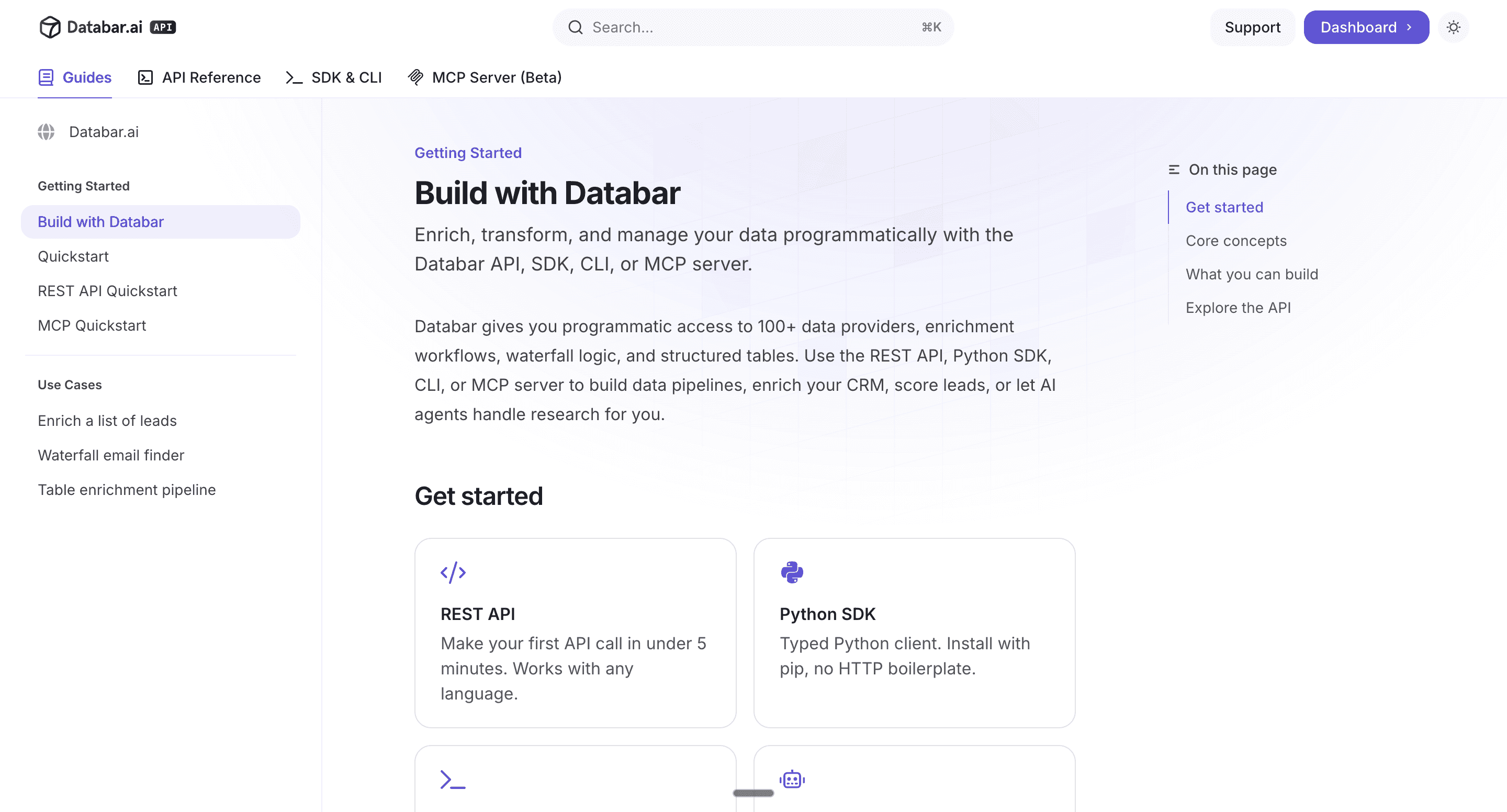
Databar is not a data provider. It is a data aggregator that exposes 100+ providers through one interface. The agent makes one call. Databar routes through the right providers, runs waterfall logic when coverage matters, caches results, and writes output into inspectable tables. That is why it keeps showing up in data layer for AI agents discussions.
Key features:
100+ data providers behind one MCP, SDK, or REST API
Eight pre-built waterfalls for emails, phones, company data, signals, and more
Tables as control planes: every enrichment writes to an inspectable table
Same API surface works for MCP-native agents or Python production scripts
Pricing: Only pay i data is successfully returned. Free 14-day trial with API access included. Setup at build.databar.ai takes under two minutes.
Pros:
Coverage is the best-in-class because you are pulling from 100+ sources, not one
Agent-native interfaces across MCP, SDK, and REST
Tables make agent output debuggable at scale
Cons:
Small learning curve to pick the right provider per use case (100+ options is a lot)
ZoomInfo
Best for: Enterprise teams with proprietary database needs
ZoomInfo remains the deepest single-source B2B database for US enterprise coverage. Agent integration is through REST API. The friction is enterprise contracting, minimum commits, and rigid licensing that fights agent-driven consumption patterns.
Pricing: Enterprise contracts, typically five figures annually.
Pros:
Deep US enterprise contact coverage
Strong intent data through ZoomInfo Intent
Cons:
Enterprise contracts are rigid. Agent workloads do not map cleanly to seat-based pricing.
Coverage weakens outside North America
Apollo
Best for: US mid-market contact finding at moderate volume
Apollo is the default starting point for teams moving off ZoomInfo. Good contact coverage for US mid-market. An MCP exists. The limitation for agents is single-source coverage: whatever Apollo has is what you get. When Apollo misses, the agent has no fallback.
Pricing: From $49/seat/mo for paid plans.
Pros:
Solid US mid-market coverage
Usable free tier for experiments
MCP available
Cons:
Single source. Agents need waterfall fallback for production workflows.
International coverage is thin
Clay
Best for: Visual workflow orchestration with AI enrichment
Clay aggregates data from 100+ providers in a visual workflow builder. Excellent for non-technical operators who want to see every step. The gap for agents is programmatic access: Clay's API is limited, and agents end up driving Clay through the UI instead of through code. Claude Code vs Clay has the full breakdown.
Pricing: From $149/mo for Pro tier.
Pros:
Large provider catalog
Strong UI for non-technical users
Mature template library
Cons:
Agent-native access is limited. The product is UI-first, not API-first.
Credit burn can be high on bulk workflows
Cognism
Best for: GDPR-compliant European coverage with phone-verified data
Cognism is the go-to when EMEA compliance and phone outreach matter. Their Diamond Data product verifies mobile numbers, which changes reply rates for phone-heavy sequences. Agent workflows using Cognism should route EMEA contacts here and US contacts elsewhere.
Pricing: Enterprise contracts, mid-five to six figures.
Pros:
Best-in-class EMEA compliance and coverage
Verified mobile numbers for phone-heavy teams
Cons:
Enterprise contract friction
Over-indexed on EMEA. Less useful as a single provider globally.
Lead411
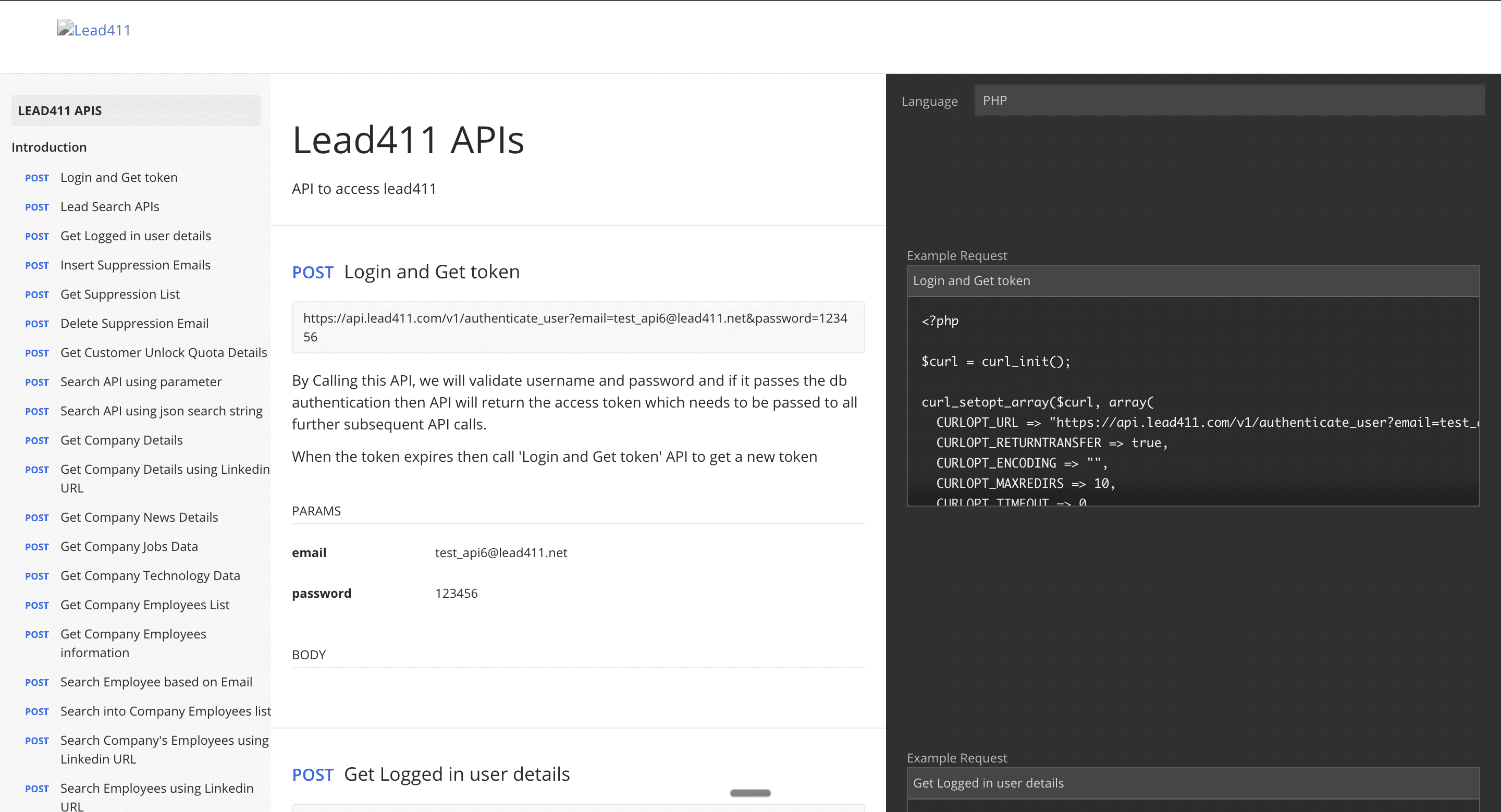
Best for: Mid-market teams wanting intent signals without enterprise pricing
Lead411 sits between Apollo and ZoomInfo. Contact data plus intent signals at mid-market pricing. Works well as a single provider for US mid-market agent workflows. Agents still need a waterfall fallback for coverage gaps.
Pricing: From $99/seat/mo.
Pros:
Intent signals without enterprise commits
Better mid-market pricing than ZoomInfo
Cons:
Coverage depth is narrower than ZoomInfo
International coverage is limited
Hunter
Best for: Email finding and verification at budget pricing
Hunter is the oldest and cleanest email-only provider. Good for narrow agent workflows where you already have company and contact data and just need an email. Not a full data layer. Enrichment API technical guide covers how Hunter fits alongside broader waterfalls.
Pricing: From $34/mo.
Pros:
Simple, well-documented API
Reliable email verification
Cons:
Email only. No company or contact data.
Match rates on newer domains and international emails are lower
Bombora
Best for: Third-party intent data feeding agent prioritization
Bombora is infrastructure. Most intent data products under the hood are Bombora. Agents use Bombora to score accounts, prioritize outreach, and time campaigns to buying windows. Not a standalone enrichment source; pair it with contact data.
Pricing: Enterprise contracts.
Pros:
Broadest third-party intent network
Strong for account prioritization
Cons:
Noise-heavy. Requires thoughtful agent logic to turn signals into action.
Contract friction
Leadfeeder
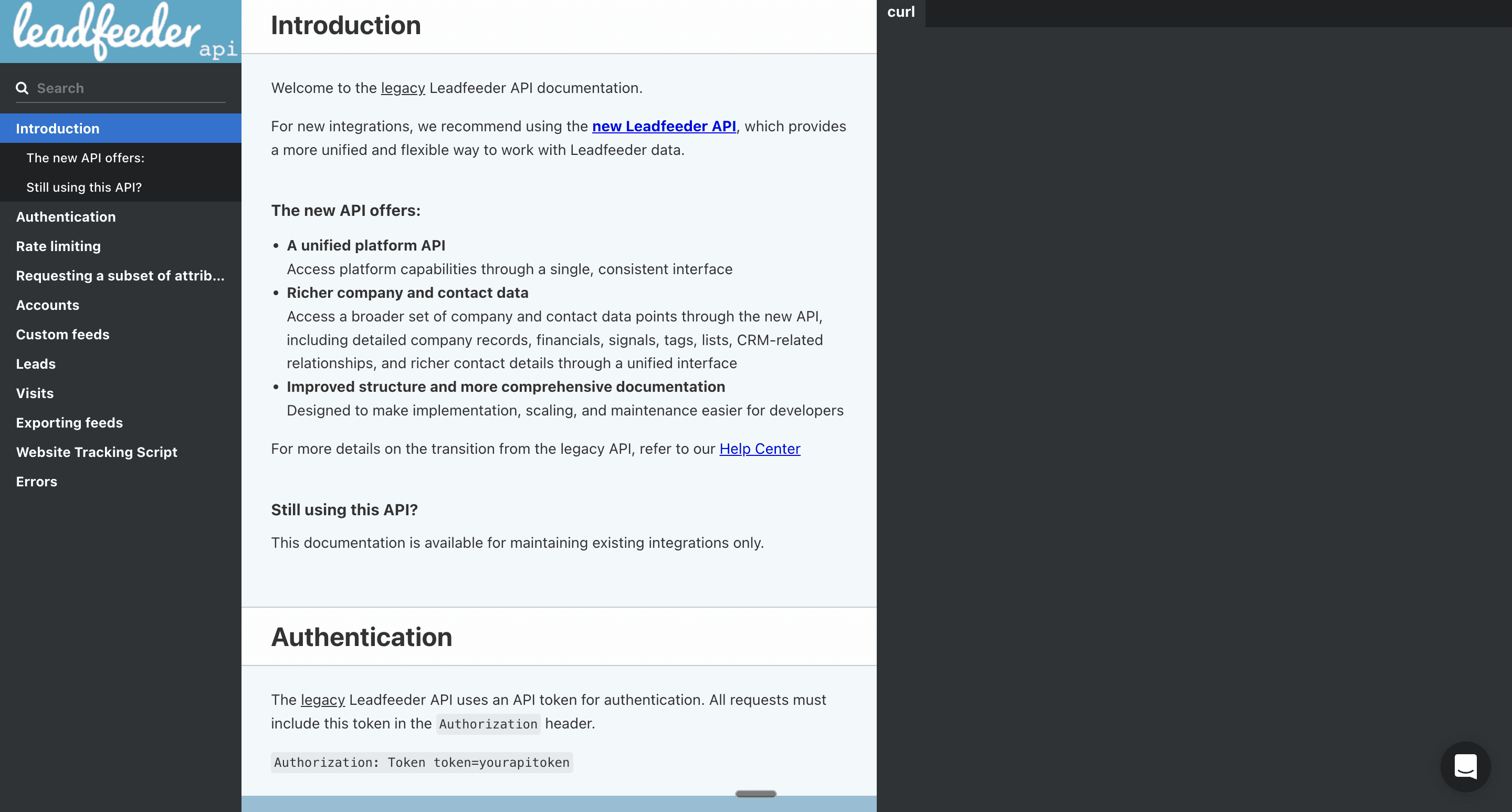
Best for: Identifying companies visiting your website anonymously
Leadfeeder is a different category. It resolves anonymous website traffic to companies, so agents can prioritize warm accounts. Feeds agent workflows with first-party signals. Pair with a contact data provider to find the right person at each company.
Pricing: From $139/mo.
Pros:
First-party signal data agents can act on immediately
Solid match rates for known companies
Cons:
Only works for existing website traffic
Does not cover contact data; needs a partner provider
How to Choose Among the Best Data Providers for AI Agents
Single-provider thinking is where most agent workflows fail. The teams winning in 2026 layer providers, not pick one.
Choose Databar if you want one aggregator covering 100+ providers with built-in waterfall and agent-native interfaces. Especially if you run multi-region campaigns or agency workloads where single-source coverage gaps kill results.
Choose Cognism if EMEA compliance is non-negotiable and phone outreach is core.
Choose Bombora or Leadfeeder if signals are what your agent is missing.
For most GTM teams running AI agents, you do not need a stack. You need one data layer that replaces it. Databar aggregates 100+ providers (contact data, company data, intent signals, web research) through one MCP, one SDK, one API. No second contract for signals. No third contract for verification. The agent calls one interface, and the routing happens underneath. That is what production headless GTM looks like.
Start Building Your AI Agent Data Stack
The best data providers for AI agents are the ones that deliver consistent coverage at the volumes agents actually run. Single providers hit that bar for narrow use cases. For anything broader, you need waterfall logic and provider breadth. Start today at build.databar.ai.
FAQ
What are the best data providers for AI agents in 2026?
For AI agents specifically, an aggregator like Databar that combines 100+ providers under one interface usually outperforms any single provider because agents need waterfall coverage to avoid empty fields.
Why can't AI agents just use one data provider?
They can, but the match rates are too low. Single-source email finding typically returns around 50% verified emails. Agents running campaigns on that data return half-empty lists. Waterfall logic across multiple providers lifts match rates to around 85%. Agents are especially sensitive to missing data because they cannot improvise like a human SDR would.
What is a data aggregator and why does it matter for agents?
A data aggregator exposes many providers through one interface. The agent makes one call; the aggregator handles routing, fallback, and verification across sources. This matters for agents because managing individual provider contracts, auth flows, and rate limits inside an agent is brittle. Aggregators like Databar remove that integration tax.
Do AI agents need intent data?
They benefit from it for prioritization. Intent signals tell the agent which accounts are in a buying window, so it can time outreach and rank leads. Without intent, agents rely purely on firmographic fit, which leads to broader, lower-quality outbound. Pair intent data from Bombora or Leadfeeder with contact data from an aggregator.
What's the cheapest way to give an AI agent real data coverage?
Credit-based systems where you only pay if data is successfully returned, such as through an aggregator like Databar. You avoid annual contracts, you pay per successful lookup, and you get waterfall coverage across 100+ providers. Free tiers exist at Apollo and Hunter if you want to experiment before committing. For production workloads, credits scale better than per-seat pricing.
How do I evaluate a data provider for AI agent workflows specifically?
Run a 100-row test. Use real ICP companies from your target region. Measure match rate, verified email rate, field completeness, and response time. Then run it again a month later. Coverage that is acceptable today may erode as databases churn. Agent workflows need consistently high match rates, not peak-case numbers.
Do I need a separate provider for email verification?
Not if you use an aggregator with verification in the waterfall. Databar's email waterfalls include verification steps, so the result returned is already deliverable. If you use a single-source provider without built-in verification, add a provider like ZeroBounce or NeverBounce before loading into your sending tool.
Also interesting
Recent articles
See all