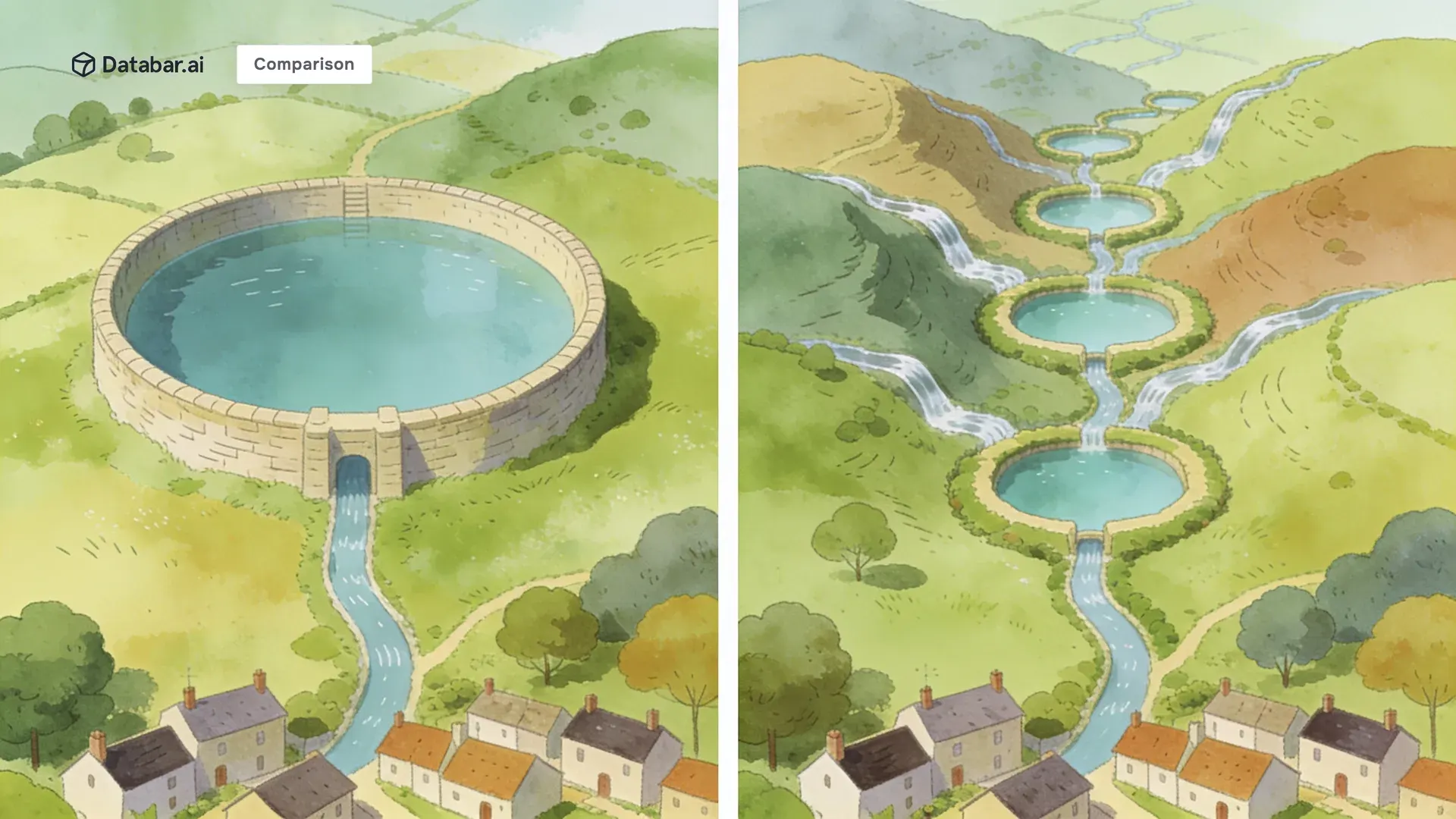
A proprietary database wins when most of your list sits in the segment that vendor covers best and you also want its bundled workflow, like sequencing or intent data. A waterfall wins when your list spans regions, company sizes or roles that no single vendor covers well, or when you want to pay only for results from many sources. Many teams end up using both.
The choice isn't about which approach is "better" in general. It's about the shape of your list, how you buy software and what sits around the data. This post lays out the trade-offs, compares how each option is priced and accessed, and gives you a test you can run on your own records before you sign anything. For the mechanics of cascades themselves, see how waterfall enrichment works.
What is the difference between waterfall and proprietary enrichment?
Proprietary enrichment means buying data from a vendor that builds and maintains its own database. Apollo, ZoomInfo and Cognism are the familiar examples. You search or enrich against one dataset, and its strengths and blind spots are the vendor's.
Waterfall enrichment means sending each record through an ordered list of providers and stopping at the first usable result. A waterfall platform doesn't own the underlying data; it gives you access to many providers and handles the fallback logic, so one provider's misses go to the next.
The line between them has blurred. Apollo's pricing page lists waterfall enrichment on its paid plans (checked September 2026), layering other sources on top of its own database. And every provider inside a waterfall is itself a proprietary database. The real question is whether one dataset is your primary source or one of several.
How do the options compare on pricing and access?
Option | Pricing model | Best for | Data coverage focus | API / MCP access |
|---|---|---|---|---|
Apollo (own database, plus waterfall on paid plans) | Per seat. Basic is $49 per seat per month billed annually with 30,000 credits per seat per year; a free plan has 900 credits per seat per year (apollo.io/pricing, September 2026) | Teams that want data, sequencing and a dialer in one tool | Its own contact and company database | API access listed on plans; official MCP server at mcp.apollo.io (docs.apollo.io, September 2026) |
Cognism (own database) | Quote-based. Standard and Pro include 5 seats; 1 credit = 1 revealed contact (cognism.com/pricing, September 2026) | Sales teams that want verified mobile data under a sales-led contract | Its own database, with premium mobile data and on-demand mobile verification on Pro | API and bulk delivery through a Data-as-a-Service add-on |
RocketReach (own database) | Per plan. Annual plans from $229 a year; a lookup is refunded if no verified email or phone is found (rocketreach.co/pricing, September 2026) | Individuals and small teams looking up contacts one by one or in lists | Its own professional profile database | API access listed on all three self-serve plans |
Databar (waterfall platform) | Credits. Build $99/month with 5,000 credits, Scale $495/month with 50,000; in a waterfall only the provider that returns data is charged | Mixed lists, custom provider order, and teams that want tables, API and agents on one account | 100+ data sources, including email, phone and company waterfalls | REST API, Python SDK, CLI and hosted MCP server |
Prices and plan contents change often; check each vendor's page before you budget. Provider-level credit prices for Databar are listed on each integration page, for example RocketReach. For a deeper look at the enterprise databases, see Apollo vs ZoomInfo and Databar vs Cognism.
When does a proprietary database beat a waterfall?
Your list sits in the vendor's core segment. Every database is strongest where the vendor has invested in collecting and checking data: a region, a company size, a set of roles. If nearly all your prospects fall there, a second or third source adds little.
You want the workflow, not just the data. Apollo bundles sequences, a dialer and deal management with its data. If you'd buy those tools anyway, one vendor can mean fewer integrations to maintain.
The field only one vendor has. Some data is genuinely exclusive: a vendor's own verified mobiles in a market it specializes in, or its intent signals. A waterfall can't produce a field that none of its providers holds.
Procurement wants one contract. Some companies strongly prefer a single annual agreement with a named account manager and a security review done once.
Reps prospect by hand. If the main use is a rep searching for people in a web app or browser extension, a database with good search filters is the right shape. Waterfalls are built for lists and automation.
When does a waterfall beat a proprietary database?
Your list is mixed. Several regions, SMB and enterprise, technical and commercial roles. Each vendor's blind spots are different, so a chain reaches people any one of them misses.
You enrich lists, not individuals. CRM backfills, inbound form enrichment, event lists and scraped lists are batch or automated jobs, which is where a cascade does its work without anyone clicking.
You want to pay per result. On Databar, lookups that return nothing aren't charged, and a waterfall stops at the first provider that returns data. That suits enrichment volume that swings from month to month.
You want control over sources. You pick which providers run and in what order, switch off one that underperforms on your segment, and keep the provider name on each record for auditing.
Software is doing the enriching. AI agents and scripts don't notice a blank field and try another tool the way a person does. Putting the fallback inside one call, through an API or MCP server, keeps coverage gaps from quietly passing through. More on that in multi-source enrichment for AI agents.
Where do both approaches fall short?
Stale data. A database refreshes on its own schedule, and a waterfall inherits each provider's schedule. Neither guarantees that someone who changed jobs last month shows up correctly. Verify emails and validate phones before sending or calling.
Verification still costs. On Databar, a provider that returns an email which then fails verification has still been charged, even though the waterfall moves on. With a database vendor, you still need to check that "verified" means what you think it means.
Compliance is per source. A record enriched by one vendor has one lawful-basis story; a record touched by several providers has several. Review the providers you enable for EU and UK contacts.
Lock-in exists either way. Moving off a database vendor means rebuilding workflows around another dataset. Moving off a waterfall platform means rebuilding provider access. Keep your enriched data in your CRM or warehouse, not only in the tool.
How do you test which approach fits your data?
Vendor-published match rates are measured on lists that aren't yours. A small bake-off takes an afternoon and gives you numbers that matter.
Build a sample of 200 to 500 records that mirrors your real mix of regions, company sizes and roles. Include records where you already know the right answer, so you can check accuracy as well as coverage.
Run the database vendor's trial on the sample and record found, correct and verified for each field you need.
Run a waterfall on the same sample with verification on, and record the same fields plus which provider found each result.
Split the results by segment. The interesting answer is usually "the database wins in segment A, the waterfall wins in segment B", not a single overall winner.
Price it per usable record. Total cost divided by records that came back correct and verified, at the volume you expect over a year.
Our guide to testing a data provider's accuracy covers how to build the answer key and score results.
What does a hybrid setup look like?
If the bake-off splits by segment, run both and route by segment. Two common patterns:
Database first, waterfall for the gaps. Reps keep the database they prospect in. Records it can't fill go to a waterfall. This fits teams whose core segment is well covered but who also sell outside it.
Waterfall by default, database for one segment. Automated enrichment runs through a waterfall, and one segment where a vendor has exclusive depth (for example, verified mobiles in a specific market) goes to that vendor.
On Databar you can also bring your own API key for many providers. Requests on your own key use actions instead of credits and are billed by the provider under your existing contract, so a vendor you already pay for can sit inside the same table or waterfall setup as everything else. For tool options beyond Databar, see the best waterfall enrichment tools, and for how per-result billing compares to other pricing models, outcome-based enrichment.
FAQ
Is waterfall enrichment more accurate than a single database?
Not automatically. A waterfall finds more records on a mixed list because providers cover different people, but each result is only as accurate as the provider that returned it. Accuracy comes from verification and from testing provider order on your own data.
Does a waterfall cost more than a proprietary database?
It depends on volume and pricing model. Seat-based databases cost the same whether you use them heavily or not. Per-result waterfalls cost more per record for hard-to-find contacts but nothing for misses. Compare total cost per correct, verified record at your real volume.
Can I use a proprietary provider inside a waterfall?
Yes. Waterfall providers are proprietary databases, and on Databar many can run on your own API key. Apollo also lists waterfall enrichment on top of its own data on paid plans.
Which approach is better for AI agents?
Agents benefit from fallback being built into the call, because they won't retry another source unless told to. A waterfall behind an API or MCP server gives an agent one tool that already tries several providers. See best data providers for AI agents.
Test both on your own list
Databar gives you email, phone and company waterfall enrichments across 100+ data sources, in tables, the API, the CLI and MCP, and only charges for providers that return data. Start free with a 14-day trial that includes 100 credits to run your bake-off sample, or book a founder demo to compare it against your current vendor on your own records.
Recent articles
See all