A rep spends 45 minutes on a discovery call with a lead the CRM flagged as hot: 90 points, opened every email, downloaded three guides. It turns out to be a student writing a thesis. The same week, the CFO of a company that matches your ICP perfectly looks at the pricing page three times and nobody on the team hears about it.
Both outcomes come from the same design choice. Most CRM scoring setups add up what a contact does, then look at which company they work for as an afterthought, if at all. The order should be the other way around: decide which accounts matter, then use contact behavior to decide when and how to engage them. This guide shows how to build that system, from account tiers to fit and intent scores, negative scoring, signal-based tier changes, and calibration.
What most lead scoring gets wrong
Points for activity, not for outcomes
A typical model gives +5 for an email open, +10 for a content download, +20 for a pricing page visit, and calls anything over 50 an MQL. Those numbers usually came from someone's sense of what feels like interest. Nobody checked whether contacts who downloaded a guide actually closed more often than those who didn't. Opening an email often means very little (and privacy features in some mail clients make open tracking unreliable anyway). Two pricing page visits in a week usually mean a lot more.
Fit and intent mixed into one number
A VP of Sales at a 500-person software company who opened one email and a student who read everything can end up with similar scores, because the model only counts engagement. Once a single number blends "who they are" with "what they did," you can't tell which one drove it.
Contacts scored without account context
A highly engaged contact at a 12-person company is not a good lead if your customers are mid-market firms with hundreds of employees. Scoring contacts before tiering accounts produces exactly that kind of false positive, and it's the main reason sales teams stop trusting scores.
Thresholds that never change
The MQL cutoff gets set once and forgotten. Nobody goes back to check which score ranges actually produced meetings and revenue, so the model drifts further from reality every quarter.
Start with account tiers
Account tiering sorts target companies by how much they are worth to you, before looking at any contact's behavior. Build tiers on more than deal size. Useful dimensions are ICP fit (how closely the company matches your best customers), revenue potential including expansion, strategic value (a recognizable logo in a target vertical, a likely reference customer), and existing relationships such as former customers or a champion who moved there.
A four-tier model works for most B2B teams:
Tier | Criteria | Treatment |
|---|---|---|
Tier 1: Strategic | Strong ICP match, large deal or expansion potential, strategic value | Named AE and SDR, researched multi-channel outreach, executive involvement |
Tier 2: Core | Strong ICP match, typical deal size | Assigned rep, personalized sequences built on templates |
Tier 3: Scale | ICP match, smaller deal size | Pooled reps, mostly automated outreach, self-serve where possible |
Tier 4: Nurture | Partial fit, or right profile but wrong timing | Marketing nurture only, no direct sales outreach |
Once tiers exist, combining them with contact scores gives reps a simple priority matrix:
Account tier | High contact score | Low contact score |
|---|---|---|
Tier 1 account | Same-day outreach from the account owner | Keep working the account; find other contacts in the buying group |
Tier 3 account | Automated sequence, and a check on whether the account deserves a higher tier | Long-term nurture with minimal effort |
A cold contact at a Tier 1 account can deserve more attention than a demo request from a Tier 4 account. That inverts how most CRMs route leads, and it is the point.
The scoring model: fit, intent, and negative points
Fit score (who they are)
Fit comes from firmographic, technographic, and contact data, and it changes slowly. An example scorecard out of 100 (the weights are a starting point; yours should come from your own closed-won data):
Company size in your target range: +20
Industry among your best-converting verticals: +20
Title matches a buying persona: +20
Funding stage or revenue band that matches past customers: +15
Uses a technology you integrate with or replace: +15
Located in a region you sell to: +10
Intent score (what they're doing now)
Intent comes from behavior, and it has to decay, since a pricing page visit from six months ago says little about today. An example:
Demo or contact request: +50
Pricing page visit in the last 7 days: +30
Comparison or alternatives page visit: +20
Return visit within 14 days: +20
Several pages in one session: +15
Points lose half their value after 30 days and expire after 90
Weight actions by what they predict, not by effort. If your data shows people who read a customer story in their own industry convert more often than people who attend a webinar, the story gets more points.
Negative scoring (who to filter out)
Negative points keep bad-fit leads from climbing on engagement alone. Look at your closed-lost and disqualified leads for patterns, and subtract points for things like:
Company too small to buy or implement your product
Regions you don't serve
Industries where you have never won a deal
Roles that never hold budget (students, job seekers, junior roles for enterprise deals)
Personal or disposable email domains, when you sell to businesses
Employees of competitors, and existing customers who should route to account management
Visits to your careers page only
Combining them
Keep fit and intent as separate fields, then decide how they combine. High fit with high intent goes straight to sales. High fit with low intent goes into targeted outreach or nurture. Low fit with high intent gets a closer look before anyone spends time on it. Whether an 80-fit, 40-intent lead outranks a 40-fit, 80-intent lead depends on your deal economics, so test both orderings against past outcomes.
How to build it
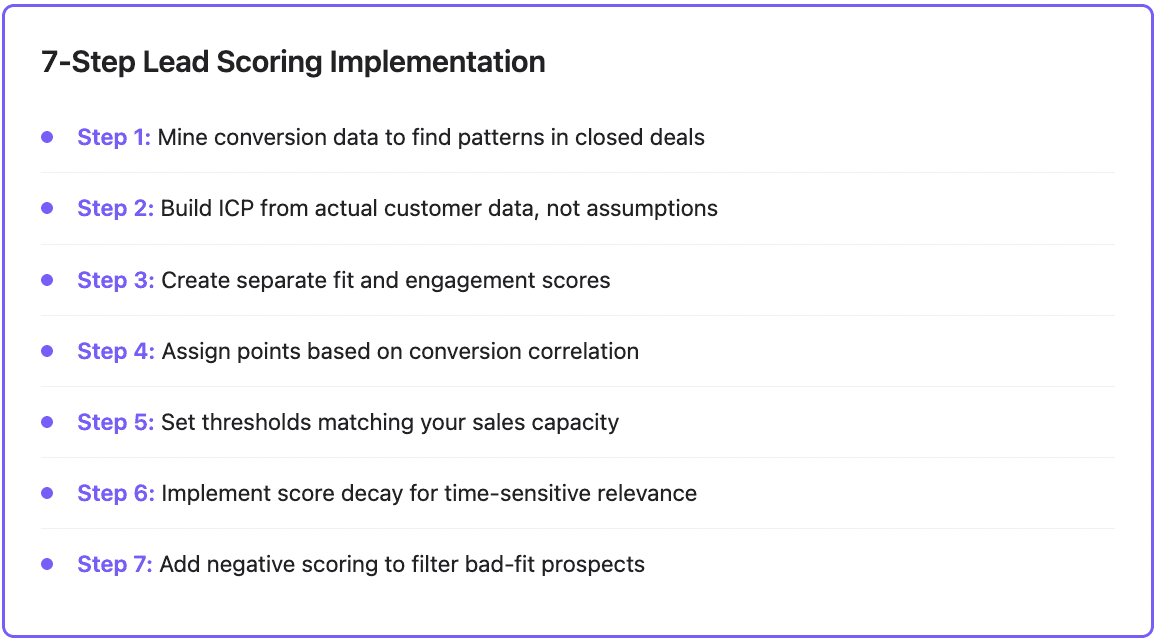
Mine your conversion data. Pull every deal closed in the last 12 months, won and lost. Note the firmographics, the titles involved, the content they engaged with, and the event that started the evaluation.
Build the ICP from real customers. If you keep aiming at large enterprises but your actual wins are 200 to 500 employee companies, the ICP should say so.
Create separate fit and intent scores. Two fields, not one blended number.
Set weights from correlation. Give the most points to attributes and actions that show up far more often in won deals than lost ones.
Set thresholds that match sales capacity. If reps can work 200 new leads a week, set the handoff threshold so roughly that many cross it. Too low floods them, too high starves them.
Add decay. Old engagement should fade automatically.
Add negative scoring. Use the disqualification patterns from step 1.
Before changing any routing, run the model in shadow mode for about 30 days. Score every lead, but let the sales team work as usual. At the end, compare scores against what actually happened: did the leads the model ranked highest book more meetings? If not, fix the weights before reps ever see a score. That month is what earns the model the team's trust.
Move accounts between tiers when signals change
Tiers set once a year go stale. An account's situation can change in a week, and your tiering should respond to events, not only to contacts clicking things.
Signals that often justify moving a Tier 2 or 3 account up, at least temporarily:
A new funding round
Several new job postings for roles that use your kind of product
A new executive in the function you sell to
Adopting or dropping a technology you integrate with or replace
A former customer contact joining the company
When an account moves up, the owner should get an alert that says what changed, links to the source (the funding announcement, the job posts), and a suggested angle for outreach that references it. Reaching out with that context is far more useful than a generic sequence. For more on reading and acting on these, see our guide to buyer intent signals.
You can run this check with a scheduled Databar table: list your Tier 2 and 3 accounts, run funding, job posting, and tech stack lookups on a recurring schedule, and send changes to your CRM or trigger a webhook when an account meets your escalation rule.
Which CRMs have built-in lead scoring and segmentation
You don't need a separate scoring tool to start. The two biggest CRMs both support the fit plus engagement approach:
HubSpot has a lead scoring tool in Marketing Hub and Sales Hub Professional and Enterprise. According to HubSpot's documentation, it supports separate engagement, fit, and combined scores for contacts and companies, positive and negative points, score decay, and High/Medium/Low thresholds. AI-built scores require Marketing Hub Enterprise and a minimum sample of converted and non-converted contacts.
Salesforce handles this through Marketing Cloud Account Engagement (formerly Pardot), where each prospect has an activity-based score and a profile-based letter grade, which maps neatly to intent and fit. Einstein Behavior Scoring adds a machine-learned score with decay, but Salesforce's Trailhead module notes it needs a meaningful history of engagement and opportunity data first.
Feature availability varies by edition and changes often, so confirm against your own plan. For other CRMs, check whether the tool can score at the account level and apply negative points; if it can't, you'll end up doing the tiering in a spreadsheet or a separate tool.
Whatever the CRM, the model can only score fields that are filled in. If most records have an email and a first name and nothing else, every fit criterion comes back empty and you are back to scoring engagement alone. Enriching company size, industry, title, funding, and tech stack when a lead is created fixes that. Databar can do this from 160+ data providers, using waterfalls so a field one source misses gets checked against the next, and sync the results to HubSpot or Salesforce. Our CRM data enrichment guide covers the setup. Paid plans start at $99/month, with a 14-day trial.
Calibrate every quarter
Once a quarter, run this check with sales and marketing in the room:
Pull leads that became closed-won in the last quarter, and leads that became closed-lost or were disqualified.
Look at the fit and intent scores each group had when they were handed to sales.
Find the criteria that show up much more in wins than in losses, and the ones that show up equally in both.
Reweight: raise the predictive criteria, lower or remove the ones that don't separate wins from losses.
Ask reps which high-scoring leads were a waste of time, and why. Their answers usually become new negative scoring rules.
Track conversion to meeting and to closed-won by score band every month, but only change the model quarterly unless something is clearly broken. Reps need a stable model to learn to trust it.
FAQ
What's the difference between lead scoring and account scoring?
Lead scoring rates individual contacts on fit and behavior. Account scoring rates the whole company, including combined engagement across everyone there. B2B purchases involve several people, so an account where three people from different teams are engaging usually matters more than one engaged individual.
Should I tier accounts or score contacts first?
Tier accounts first. A high-scoring contact at an account that will never buy is still a dead end. Tiers decide how much effort an account deserves; contact scores decide when to act and who to talk to.
Should I use AI or machine learning for lead scoring?
Start with rules. They are easy to explain and easy to fix. Predictive scoring needs enough history to learn from: a solid base of both won and lost outcomes, and clean fields on those records. If you have only a few dozen closed deals, a rule-based model built from them will do as well and your team will understand it.
Why do high-scoring leads go quiet after the demo?
Usually the model rewards content consumption that doesn't predict buying. Someone can read everything you publish and have no budget or authority. Add negative scoring for missing qualifications, weight fit more heavily, and look at what the leads who went quiet had in common before the demo.
How do I know if the scoring model works?
Compare conversion to meeting and to closed-won across score bands. Higher bands should convert clearly better than lower ones. If the rates are about the same across bands, the model isn't sorting anything, and it's time to go back to your closed-won data.
Recent articles
See all